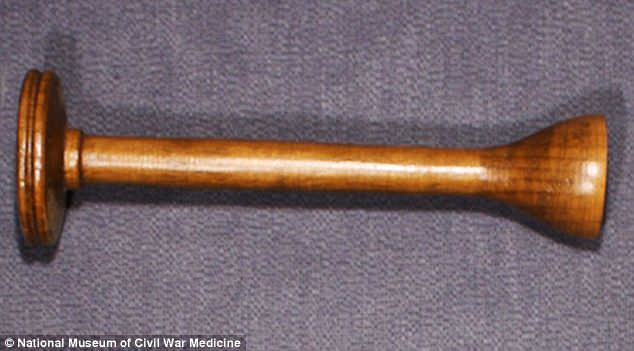
Smoothly turned wood and a simple, trumpet-like profile define this early stethoscope, a tool that looks more like a craftsman’s instrument than a piece of medical equipment. The flat end was pressed to a patient’s chest or back, while the flared cup at the other end carried the sound to the physician’s ear. Its worn sheen hints at repeated handling, when careful listening was among the few diagnostic advantages a doctor could reliably bring to the bedside.
Before flexible tubing and dual earpieces became standard, auscultation depended on devices like this to amplify faint internal clues—breath sounds, heartbeats, and the subtle changes that might suggest infection or injury. The wooden body acted as a straightforward conduit for vibration, giving practitioners a more focused way to “hear” the body than placing an ear directly against clothing or skin. In the world of Civil War medicine and other 19th-century practice, that small improvement could matter when time, sanitation, and resources were in short supply.
For readers interested in medical history artifacts, this wooden stethoscope is a reminder of how diagnosis once rested on close observation and trained senses rather than laboratory tests and imaging. The object’s plain construction also speaks to portability: it could be carried, cleaned, and used in settings ranging from hospitals to makeshift wartime stations. Seen today, it bridges the gap between craft and science, marking a pivotal step in the evolution of the stethoscope and the everyday work of physicians in the past.