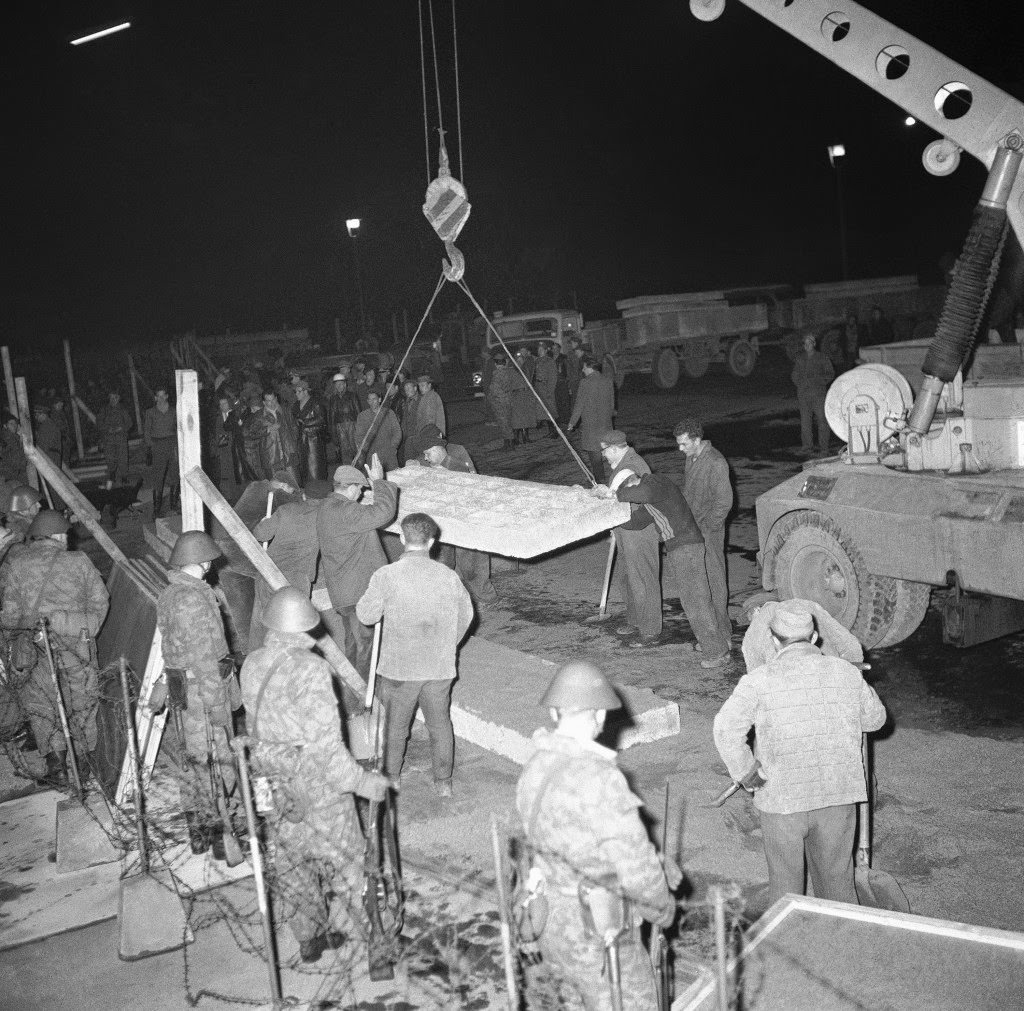
Floodlit darkness frames a tense worksite as East German workmen guide a crane’s hook, steadying a heavy concrete slab while it hangs just above the ground. Helmets and coats cluster around the block, hands raised to signal and brace, while armed guards stand watch in the foreground near coils of wire and makeshift barriers. Trucks idle in the background, turning the scene into an assembly line of separation rather than a simple construction job.
In front of the Brandenburg Gate in East Berlin on Nov. 19, 1961, the Wall is not an abstract symbol but a physical object being lowered into place—measured, aligned, and fixed by ordinary labor under extraordinary pressure. The choreography of men and machinery hints at urgency: quick decisions, tight control, and a visible security presence that transforms civic space into a militarized boundary. What should be an open monument becomes a backdrop to division, with concrete and steel replacing passage and ceremony.
For readers tracing Cold War history, the Berlin Wall’s early days, or the transformation of Berlin’s cityscape, this photograph offers a grounded view of how borders are built in real time. It carries the stark contradiction of modern urban life under political fracture: workers focusing on inches and angles while the larger stakes—movement, family ties, and freedom—hang overhead as palpably as the slab on the crane. Seen today, the scene at the Brandenburg Gate remains a powerful reminder that walls are constructed one block at a time, yet their consequences reach far beyond the worksite.