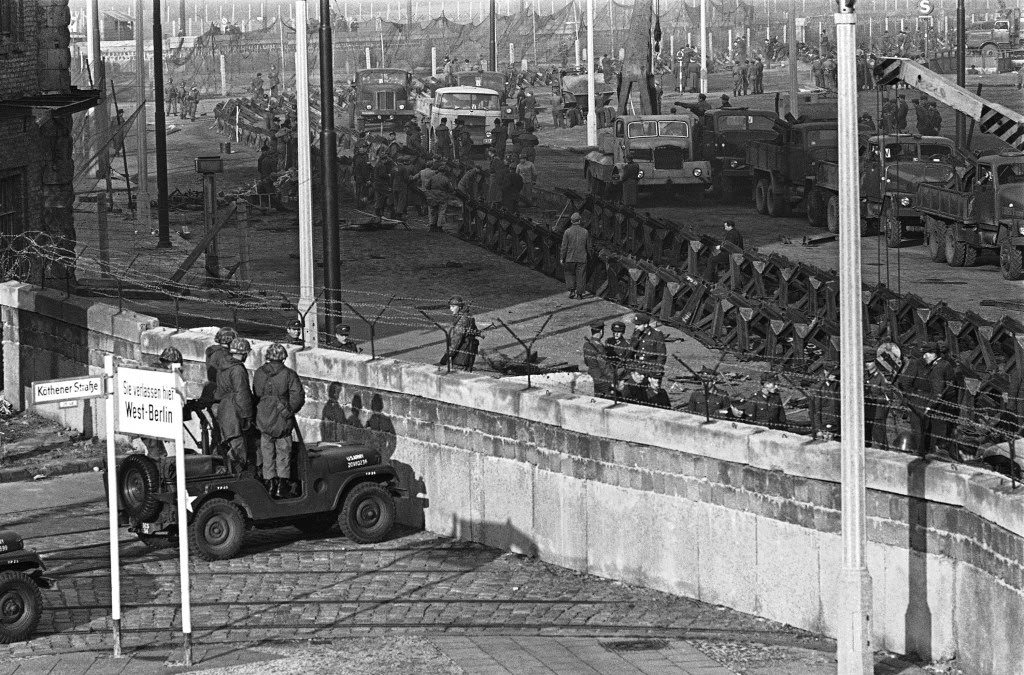
Steel beams, barbed wire, and a growing line of concrete set a hard boundary across the street as East German workmen direct a crane lowering another block into place. In the foreground, a small cluster of onlookers stands in an open vehicle near a road sign pointing toward “West-Berlin,” while uniformed personnel watch from behind the barrier. The scene feels both industrial and intensely human—ordinary labor and heavy machinery pressed into the service of a political division.
Brandenburg Gate looms nearby in the story of this moment, turning an iconic monument into a backdrop for rapid fortification in East Berlin on Nov. 19, 1961. Trucks, temporary fencing, and anti-vehicle obstacles fill the space where movement once flowed more freely, suggesting the speed and scale with which the border was being consolidated. The composition emphasizes layers of separation: first wire, then barricades, then the rising wall—each addition tightening control.
For readers exploring Cold War history, this photograph distills the Berlin Wall’s construction into a single, unsettling snapshot of work in progress. It evokes the city’s sudden fracture, when streets became checkpoints and familiar routes ended at concrete. As a historical photo of East Germany, Berlin, and the Brandenburg Gate, it offers a stark, SEO-friendly window into how a geopolitical conflict was built block by block on the ground.