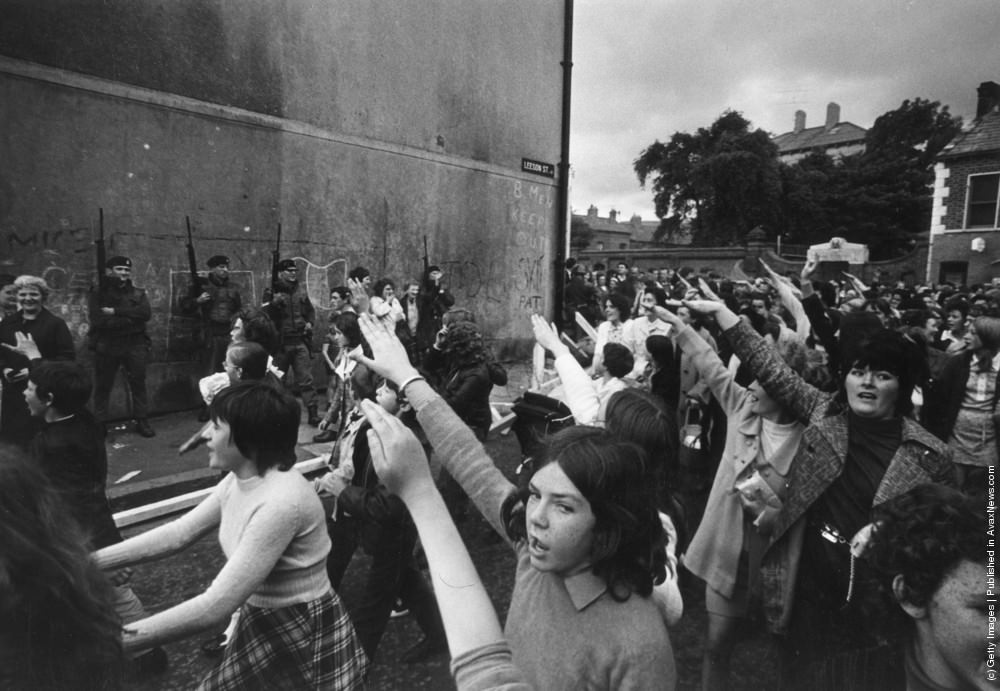
July 1970 in Belfast’s Falls Road area feels close enough to touch in this scene on Leeson Street, where a packed crowd of demonstrators moves past a line of British soldiers posted along a high wall. Many hands are raised—some in gesture, some in appeal, some in defiance—while the troops stand spaced apart with rifles held ready, watching the flow of people. The street sign for “LEESON ST.” fixes the moment to a specific corner, anchoring a tense passage through an ordinary neighborhood turned into a stage for confrontation.
Faces dominate the foreground, bringing the human scale of civil unrest into sharp relief: young men and women pressed shoulder to shoulder, mouths open mid-chant, bodies angled forward as if propelled by urgency. Across from them, the soldiers’ rigid posture and dark uniforms create a stark visual boundary, reinforced by the blank expanse of wall behind them. Even without hearing the noise, the photograph suggests a charged atmosphere where movement itself becomes a political act—walking, raising a hand, meeting a gaze.
For readers searching the history of the Troubles, this image offers a vivid snapshot of how protest, policing, and military presence collided on Belfast streets in 1970. It captures the uneasy proximity between civilians and armed forces, hinting at how quickly public demonstrations could sharpen into something more dangerous. As a historical photo for a WordPress post, it invites reflection on the everyday geography of conflict—streets, corners, and crowds—where larger struggles were lived in real time.