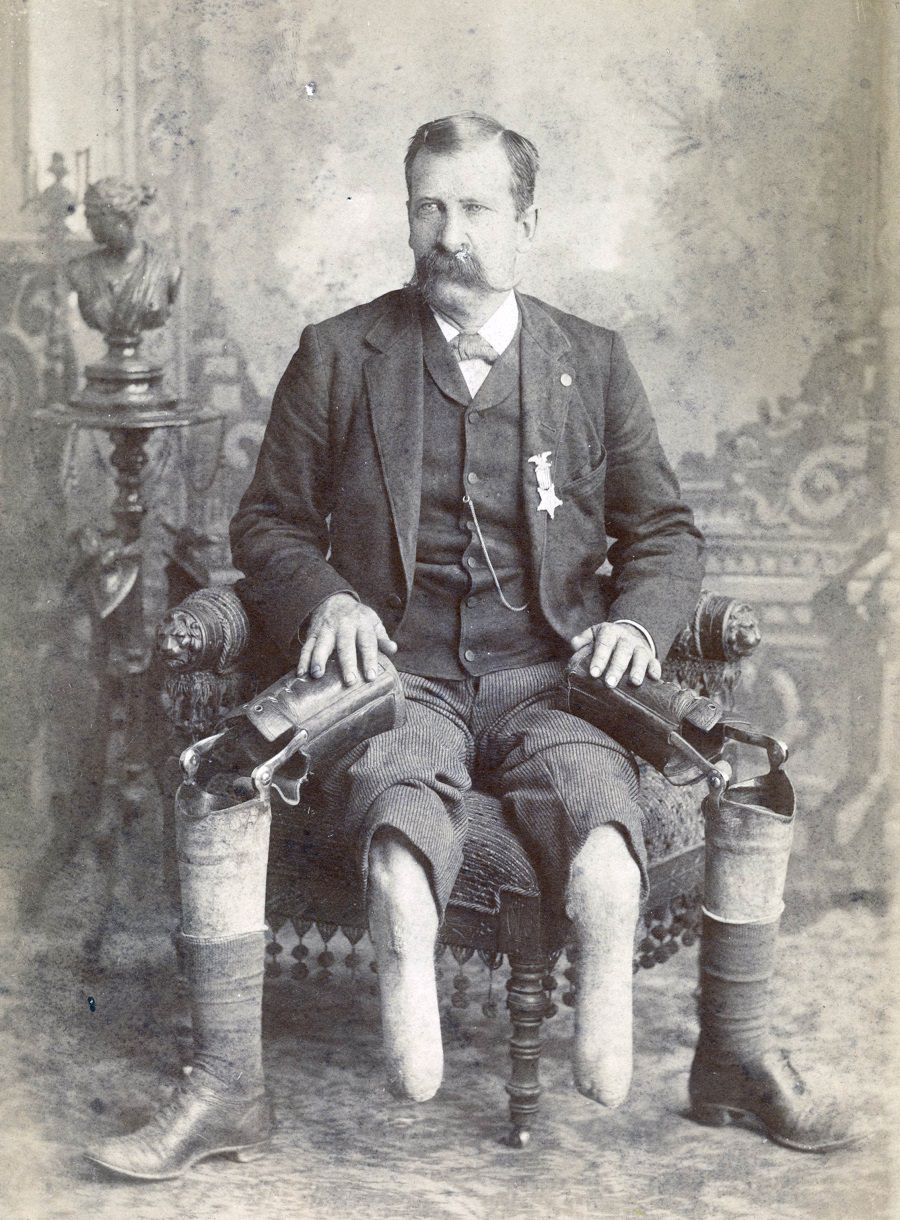
Seated squarely in a studio chair, John W. January meets the camera with a steady, unsentimental gaze that feels as direct today as it must have in 1890. His suit is carefully worn and a small medal or badge is pinned to his jacket, a quiet nod to service rather than spectacle. The painted backdrop and ornamental props place the portrait firmly in the late-19th-century world of formal photography, where dignity was often as important as documentation.
What draws the eye is the frank visibility of his prosthetic legs: sturdy, practical devices with straps and metal fittings that speak to the era’s evolving approaches to disability and rehabilitation after the Civil War. January’s posture—hands resting calmly on the chair arms—suggests both composure and accommodation, as if the portrait is meant to record not only a veteran’s identity but the realities of life after wartime injury. Details like the cut of his trousers and the heavy footwear underline the everyday engineering of mobility in a period before modern prosthetics.
As a veteran of Company B, 14th Illinois Cavalry Regiment, January represents thousands of Union soldiers who carried the war into peacetime in visible and invisible ways. For readers exploring Civil War history, veteran portraits, and the material culture of recovery, this image offers more than a face—it offers evidence of resilience, adaptation, and the social language of honor in postwar America. The photograph invites lingering attention to small things: the pinned insignia, the careful studio arrangement, and the human presence at the center of it all.