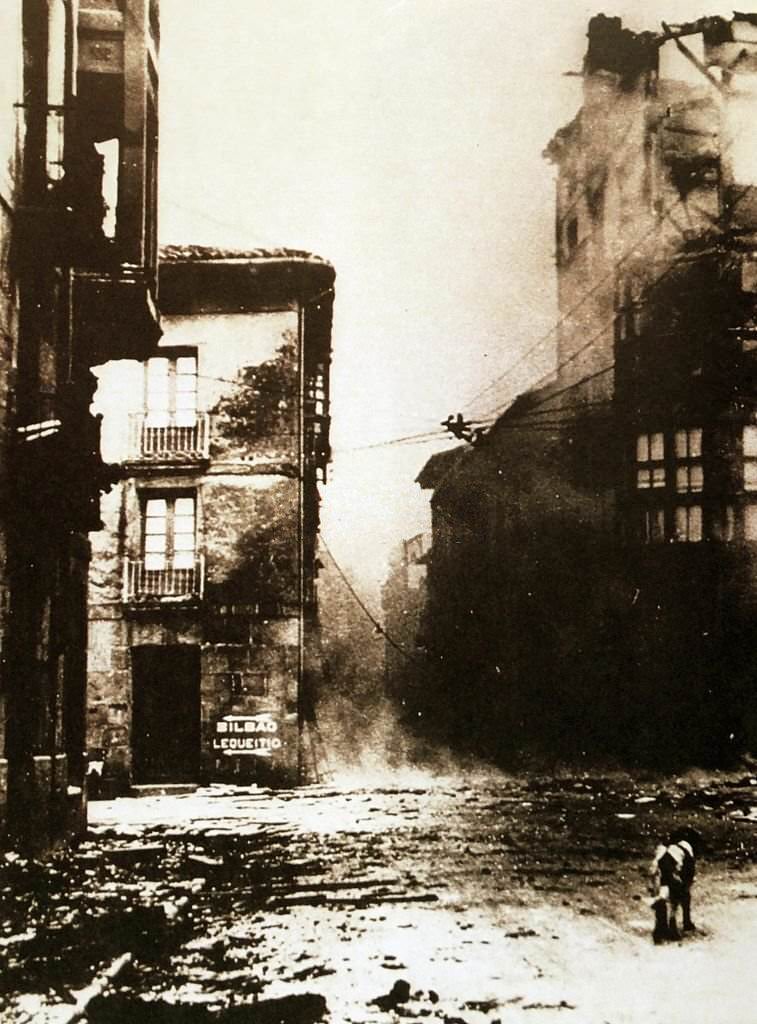
Charred façades and shattered windows frame a street that has been turned into a corridor of rubble, the air still hazy with dust and smoke. Along the left side, balconies cling to a battered building while the opposing structure rises as a dark, scorched mass, its upper floors torn open. Near the bottom edge, a small figure bends close to the ground, emphasizing the scale of destruction left by the air raid on Guernica, Spain.
In the distance, a directional sign marked “Bilbao” and “Lequeitio” anchors the scene in the Basque Country and hints at the routes that once guided everyday movement and trade. Now those familiar markers point through a landscape of debris, where street surfaces are buried under broken masonry and ash. The photograph’s stark contrast and empty roadway evoke the unsettling quiet that follows bombardment, when the city’s usual sounds have been replaced by the aftermath.
During the Spanish Civil War, Guernica became a symbol of how modern warfare could reach beyond battle lines and into civilian life, leaving town centers and homes exposed from above. For readers searching the history of the Guernica bombing, Basque history, or Spanish Civil War air raids, this image offers a direct, ground-level view of the damage: architecture ripped apart, streets stripped of normality, and survivors left to pick through what remains. It is a reminder that the story of war is often written not only in military reports, but in the broken streets where communities had to begin again.