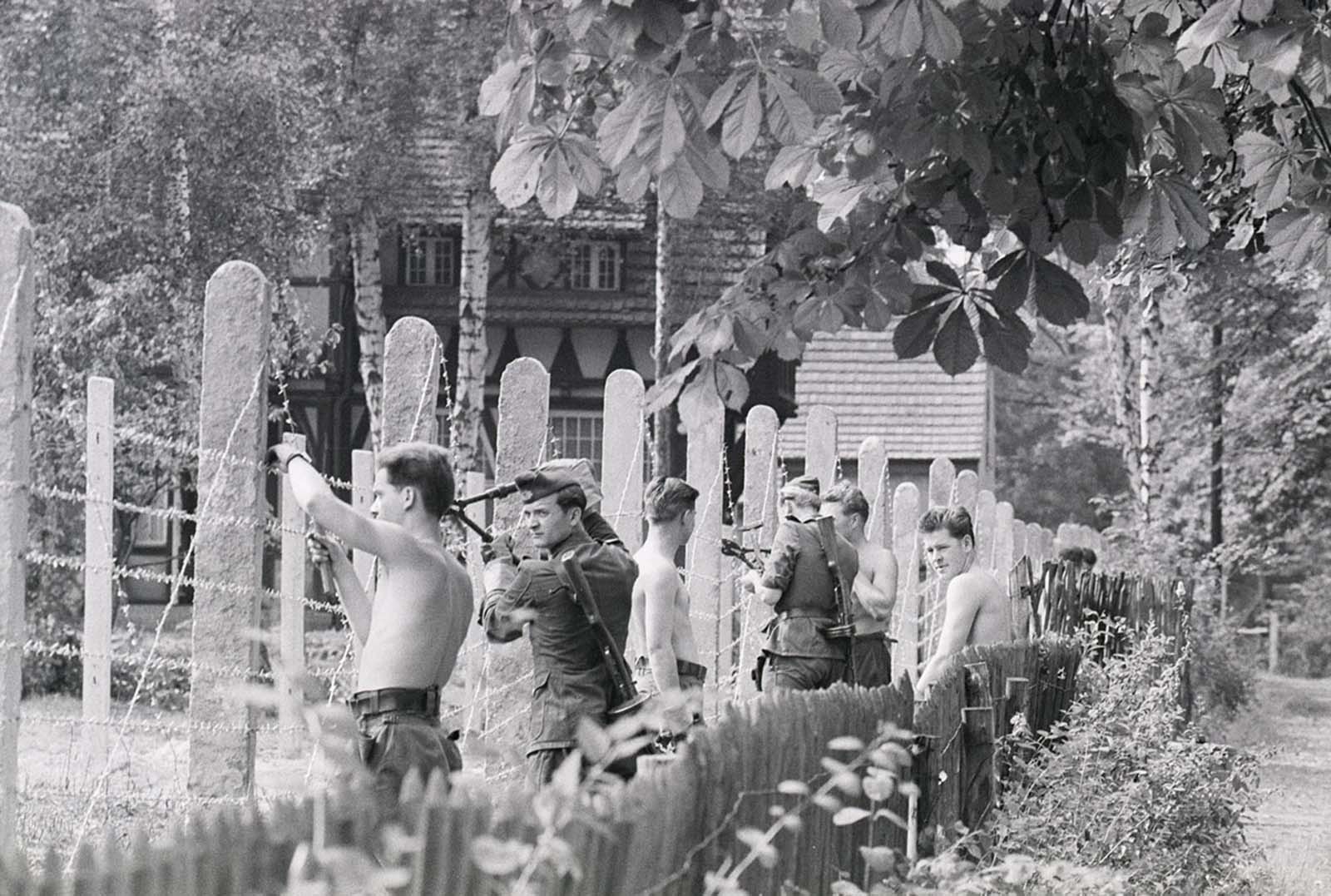
Along a modest fence line shaded by trees, Communist People’s Police officers work methodically to thread barbed wire through a run of stout posts, turning a previously ordinary boundary into a hard barrier. The scene, set in September 1961 between East and West Berlin, feels almost domestic at first glance—houses and foliage in the background—yet the wire and the men’s purposeful posture make the message unmistakable.
Uniformed figures with slung rifles stand close as others tighten the strands, a mix of watchfulness and routine labor that speaks to the sudden militarization of everyday space. What might resemble a neighborhood edge or garden border is being refashioned into a frontline, capturing an early phase in the construction of what would become the Berlin Wall system and the Cold War division of the city.
For readers tracing the history of Berlin in 1961, the power of this photograph lies in its quiet realism: control imposed not only through grand architecture, but through incremental acts—posts, wire, patrol, and the steady narrowing of movement. It evokes the human stakes behind political decisions, when a city’s streets and relationships were cut and constrained, leaving a lasting imprint on families, communities, and the memory of a divided Germany.