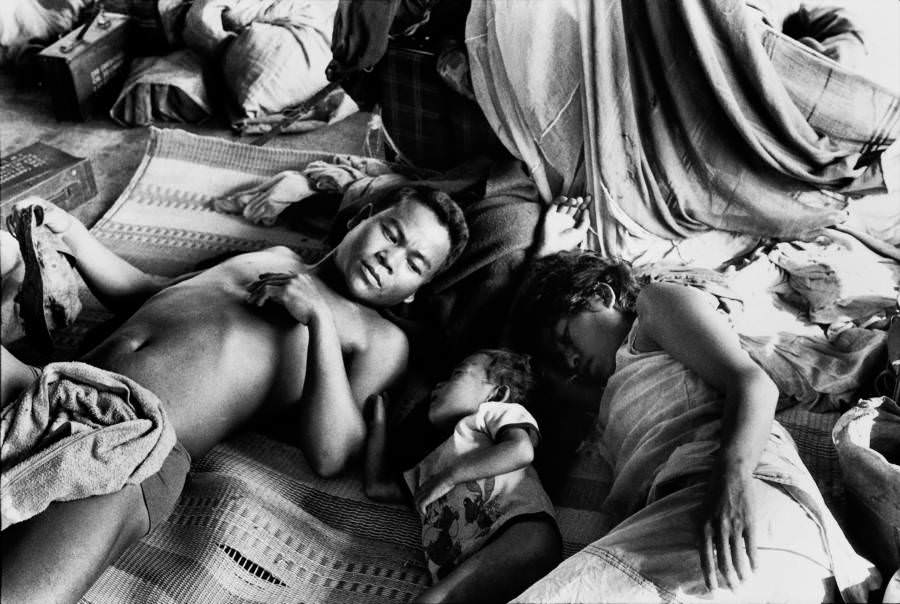
Inside Phnom Penh’s Olympic Stadium in 1975, a group of Cambodian soldiers lies shoulder to shoulder on rough mats, surrounded by bundled cloth, sacks, and the small, ordinary clutter of survival. The tight framing turns the arena’s vastness into an intimate, crowded refuge, where exhaustion is visible in slack hands and half-closed eyes. Faces and bodies are presented without ceremony, suggesting a pause between danger and duty rather than any sense of triumph.
The title’s stark context—fighters opposed to the Khmer Rouge occupying a stadium later associated with executions—casts a long shadow over these quiet details. A venue built for sport and public spectacle becomes, in the logic of civil war, a place of detention, waiting, and fear, its meaning rewritten by whoever holds power. The photograph’s calm surface intensifies the unease: rest looks temporary, and the boundary between shelter and threat feels thin.
For readers searching the history of Cambodia’s civil wars and the fall of Phnom Penh, this scene offers a human-scale entry point into a period often told in numbers and slogans. It reminds us that conflict is lived in cramped corners and improvised bedding, in bodies that must sleep even when the future is unknowable. The Olympic Stadium, here reduced to a makeshift living space, stands as a powerful symbol of how quickly ordinary public places can be transformed by violence.