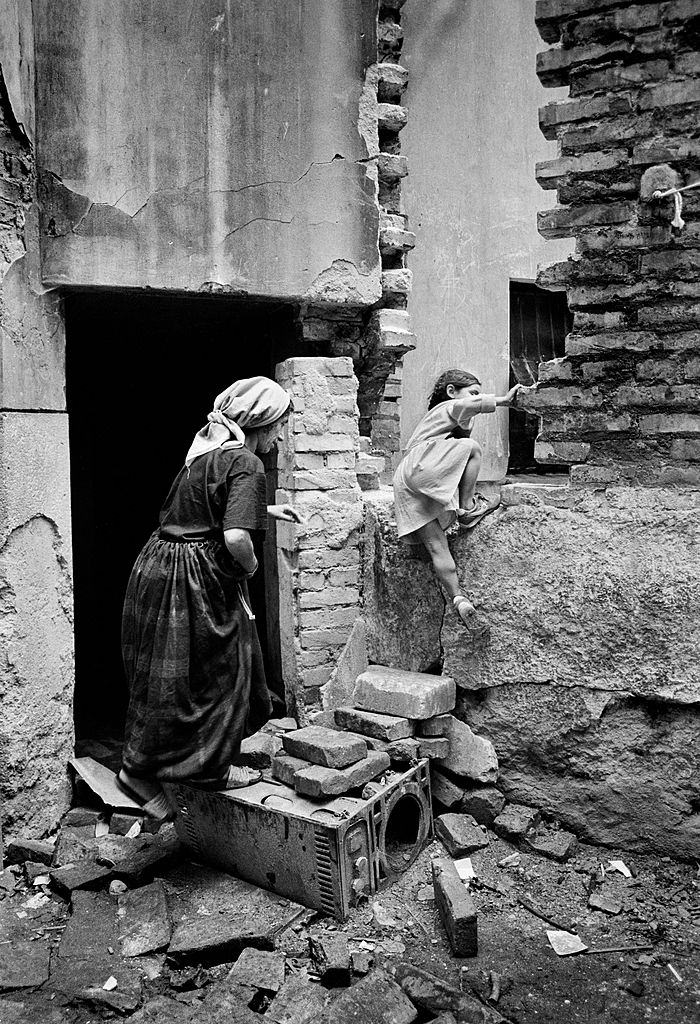
Amid fractured brickwork and yawning doorways, a mother pauses at the threshold while her child scrambles over rubble to reach what used to be the entrance. The walls are split open, exposing layers of masonry like a wound, and the ground is littered with broken stones and household debris—an ordinary domestic space turned hazardous terrain. In the stark light, the figures appear small against the damage, yet their movement suggests purpose: returning, entering, continuing.
Seen through the lens of the siege of Sarajevo in 1992, the scene speaks to the daily improvisation demanded by urban warfare on a civilian frontline. A radio lies half-buried beneath bricks, a quiet reminder that communication and news once flowed through this home before shelling and blasts reshaped it. The child’s outstretched arm toward the shattered wall reads as both balance and determination, while the mother’s posture carries the wary attention of someone who has learned to read danger in familiar streets.
For readers searching for historical photos of the Bosnian War, Sarajevo under siege, or the lived experience of civil wars, this image offers a grounded, human-scale view of conflict’s aftermath. It doesn’t rely on uniforms or weaponry to convey violence; instead, it shows how war invades the private world of family and shelter. The act of entering a bomb-damaged house becomes a testament to endurance—one careful step at a time, over the remnants of what was normal.