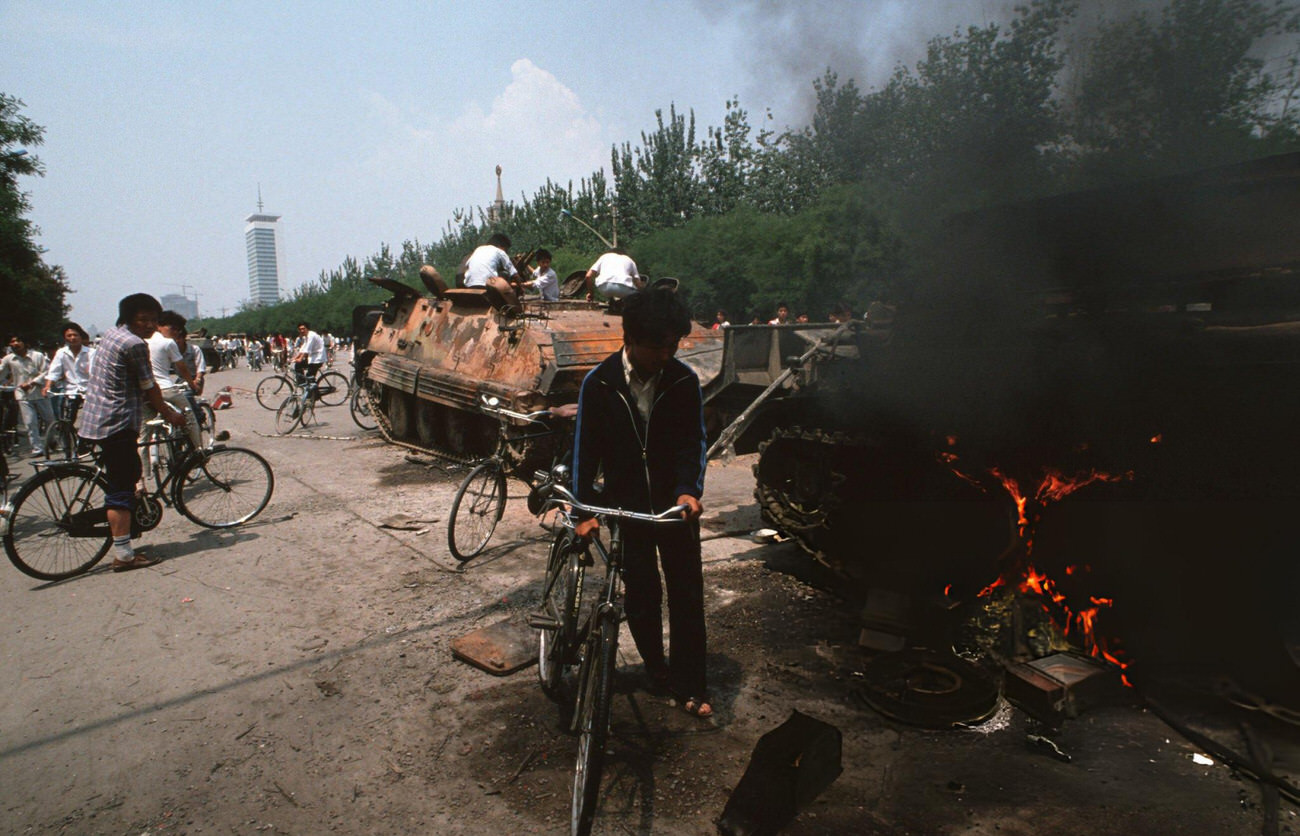
Smoke coils into a bright summer sky as civilians drift along a broad boulevard, bicycles threading through scattered debris. At the road’s edge, a burned-out military vehicle still smolders, its twisted metal and lingering flames turning the curbside into a makeshift warning. In the middle distance, more damaged Chinese Army trucks and armored vehicles sit immobilized, their scorched surfaces attracting steady attention.
Small groups gather and climb for a closer look, treating wreckage like evidence to be inspected rather than an obstacle to avoid. The contrast is striking: everyday street life—pedaling, walking, pausing to stare—unfolds beside the unmistakable aftermath of violence. Without needing close-ups of faces, the scene conveys the uneasy mix of curiosity, shock, and uncertainty that follows a sudden rupture in public order.
Set in 1989, the photograph aligns with the post’s “Civil Wars” framing by showing how conflict reshapes ordinary urban space into a contested landscape of ruined equipment and watchful crowds. It offers a grounded visual record for readers searching for historical context on Chinese Army vehicles damaged or destroyed, and on the role of onlookers in moments of political upheaval. What remains most memorable is not just the wrecked machinery, but the way civilians reclaim the street—slowly, cautiously—while the smoke has not yet cleared.