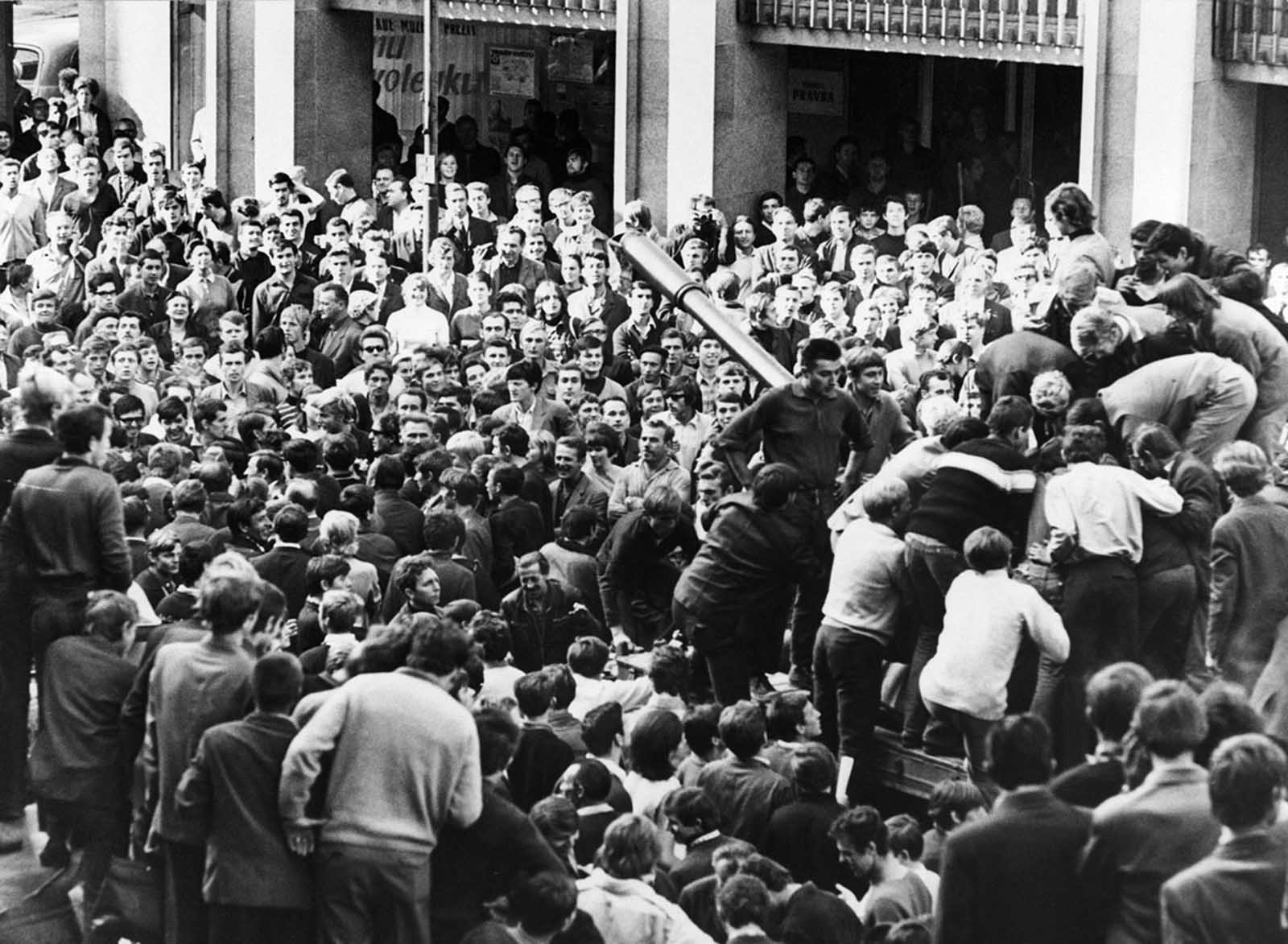
Crowds pack a Bratislava street until there seems to be no empty space left, their faces turned toward the same hard focal point: a Soviet tank wedged amid bodies and concrete. Men climb onto the turret and hull, leaning over the metal as if to reclaim it through sheer proximity, while the long barrel cuts diagonally through the scene like an accusation. Behind them, the colonnaded façade and shopfront windows become a kind of public gallery, rows of onlookers stacked shoulder to shoulder.
Anger here is not abstract; it has weight and texture, expressed in clenched stances, raised arms, and the risky decision to approach armored power at arm’s length. The act described in the title—mocking the crew—reads in the photograph as a defiant performance staged on the occupier’s machine, a brief inversion of control played out in full view of the city. Even without hearing the shouts, the density of the gathering suggests a collective refusal to be reduced to spectators of their own fate.
August 22, 1968 sits in memory as part of the Warsaw Pact invasion that crushed the Prague Spring, and this Bratislava moment distills that rupture into a single frame. For readers searching Cold War history, Czechoslovakia 1968, or the Soviet invasion of Czechoslovakia, the image offers more than military hardware—it shows civic courage pressed against steel. It also hints at how “civil wars” can feel without formal battle lines: neighbors and strangers forced into a shared, dangerous closeness as politics arrives in the street on tracks.