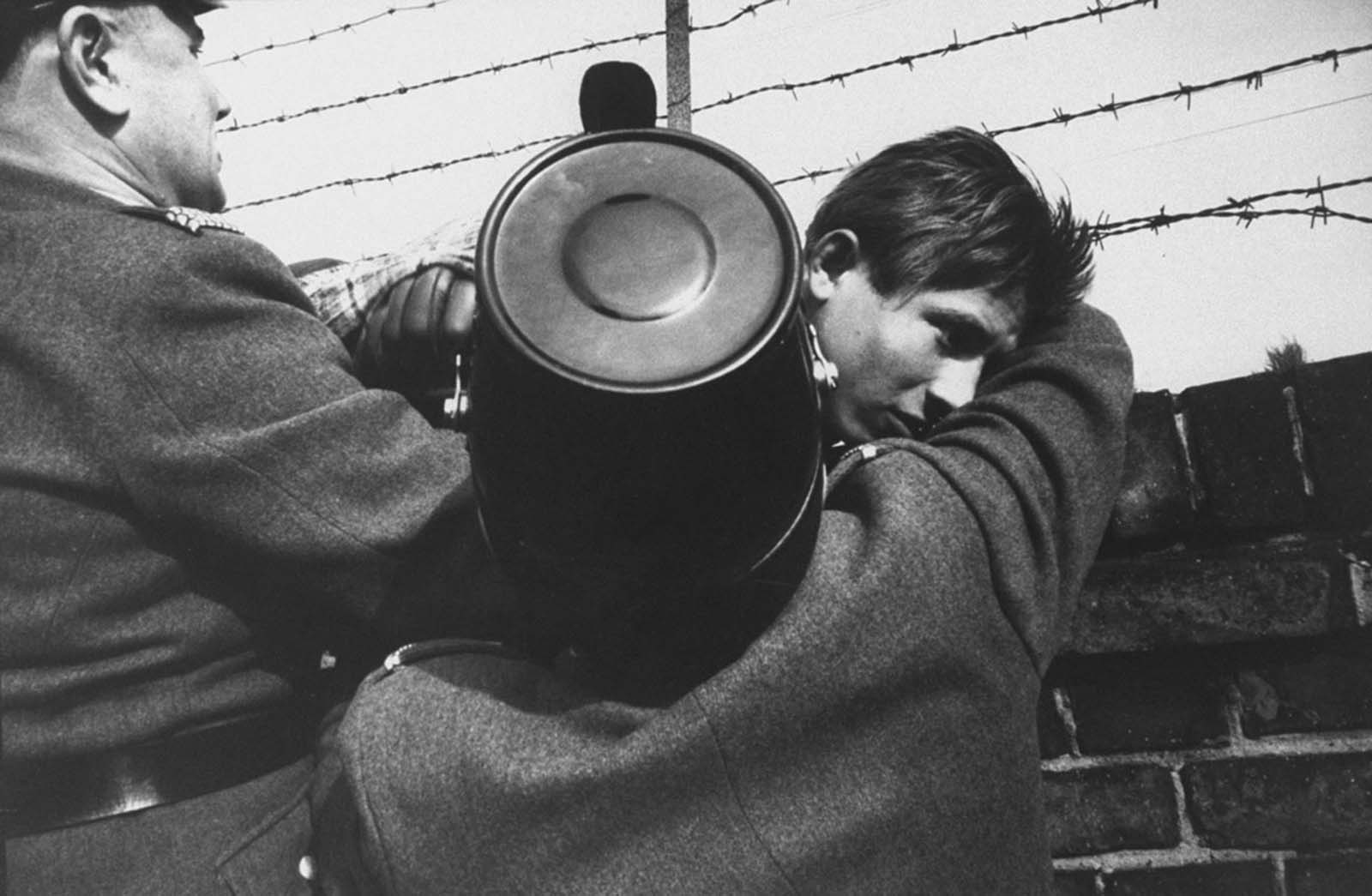
Barbed wire cuts across the sky like a hard underline, turning an ordinary city boundary into a battlefield of nerves. In the foreground, two uniformed West Berlin police officers brace a slim teenager as he comes down from the Berlin Wall, their arms forming a human ladder against the rough brick. The boy’s face is tense and focused, his body folded inward as if still listening for shouts behind him, while the officers’ steady grip suggests practiced urgency rather than spectacle.
Taken in October 1961, only weeks after the barrier’s sudden construction, the moment compresses the early Cold War crisis in Berlin into a single breath. The wall is not yet the sprawling concrete system it would become; it reads here as a jagged improvisation—masonry topped with wire—yet already powerful enough to dictate who may move, who may not, and at what cost. The frame hints at how quickly daily life was militarized, with police, fences, and hurried rescues replacing sidewalks and open streets.
For readers searching the history of the Berlin Wall escape attempts, this scene stands out for its quiet, immediate humanity. It is about borders and ideology, but also about hands reaching out at the decisive second when fear meets relief. The photograph invites a closer look at the earliest days of a divided Berlin, when a 17-year-old’s leap toward freedom depended as much on courage as on the willingness of strangers in uniform to catch him.