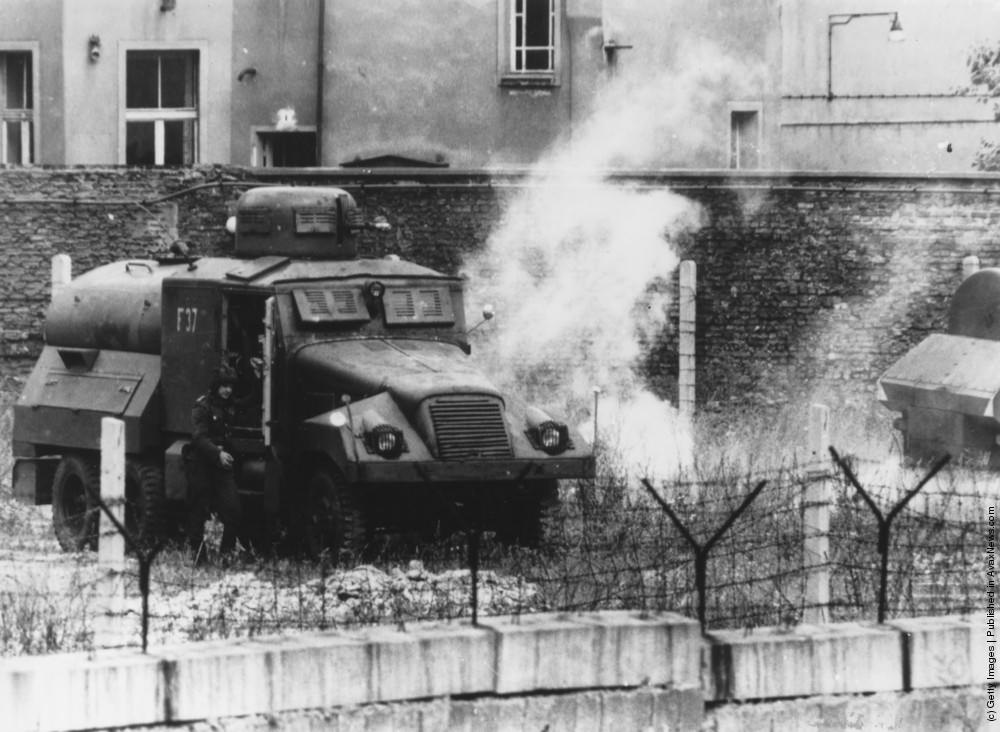
Smoke billows up in a sudden white burst beside an armoured car, turning a guarded stretch of wall and wire into a scene of immediate panic and confusion. The vehicle’s heavy frame and small observation points feel built for control, yet the erupting tear gas grenade suggests that control was being contested in the street. Behind it, plain building facades and a long brick barrier underline how ordinary urban spaces could become front lines during Cold War unrest.
Set against the first anniversary of the Berlin Wall’s construction, the photograph speaks to a year in which the border was still raw, newly hardened, and fiercely symbolic. Barbed wire, concrete blocks, and military hardware form a stark vocabulary of separation, while the gas cloud hints at crowds just outside the frame—people close enough to challenge authority, close enough to be dispersed. Even without visible faces, the tension between state security and public anger is legible in the posture of the vehicle and the violence of the plume.
For readers exploring civil conflict, protest history, and Berlin Wall imagery, this moment distills how quickly political crisis could become physical confrontation. The composition draws the eye from defensive obstacles in the foreground to the armoured car and the blast, mapping a layered landscape of barriers meant to deter movement and dissent. It’s a reminder that the Wall was not only a line on a map, but a lived battleground where unrest, policing, and propaganda collided in real time.