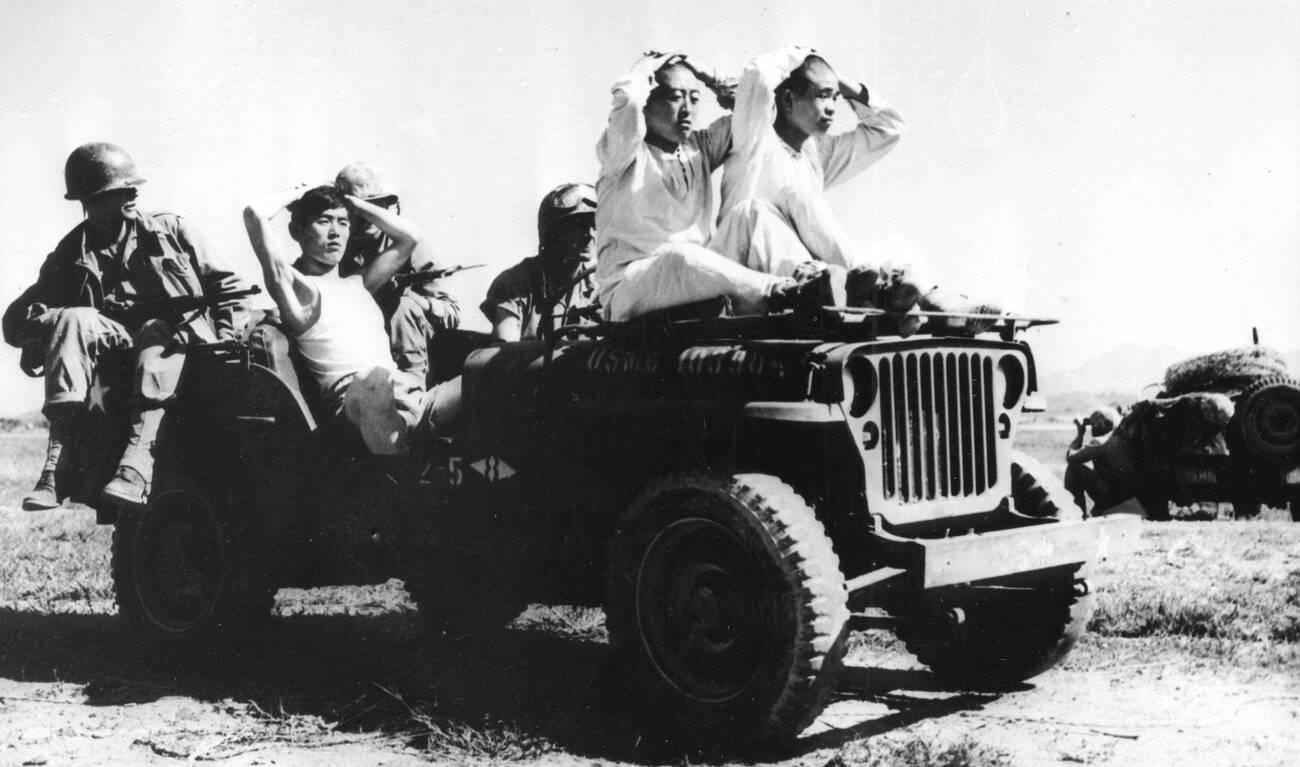
Perched on the hood of a military jeep, several North Korean prisoners of war sit with their hands clasped over their heads while U.S. troops ride alongside, rifles at the ready. The stark posture of surrender contrasts with the open landscape behind them, turning a routine transport into a tense tableau of control, exhaustion, and uncertainty. Details like helmets, field gear, and the utilitarian vehicle design ground the scene firmly in the mid‑20th‑century conflicts that shaped the Korean Peninsula.
Moments like this help explain why the 1950s remain so central to Korean War history: they show the war not only as strategy and headlines, but as lived experience measured in short rides, guarded silence, and improvised security on dusty roads. The prisoners’ light clothing and the soldiers’ combat kit highlight the unequal conditions that could exist within a single frame, while the prisoners’ elevated position on the vehicle makes them both visible and vulnerable. It’s an image that invites viewers to consider the mechanics of captivity—movement, surveillance, and the ever-present possibility of violence—without needing dramatic scenery.
For readers searching for Korean War photographs, U.S. Army imagery, or accounts of prisoners of war in the 1950s, this photo offers a powerful primary source in visual form. It also complicates the shorthand of “Civil Wars” by pointing to an international conflict where local divisions were intensified by outside forces and global politics. As a historical artifact, it encourages careful viewing: not to sensationalize suffering, but to remember how quickly lives could be reduced to compliance and transport in wartime.