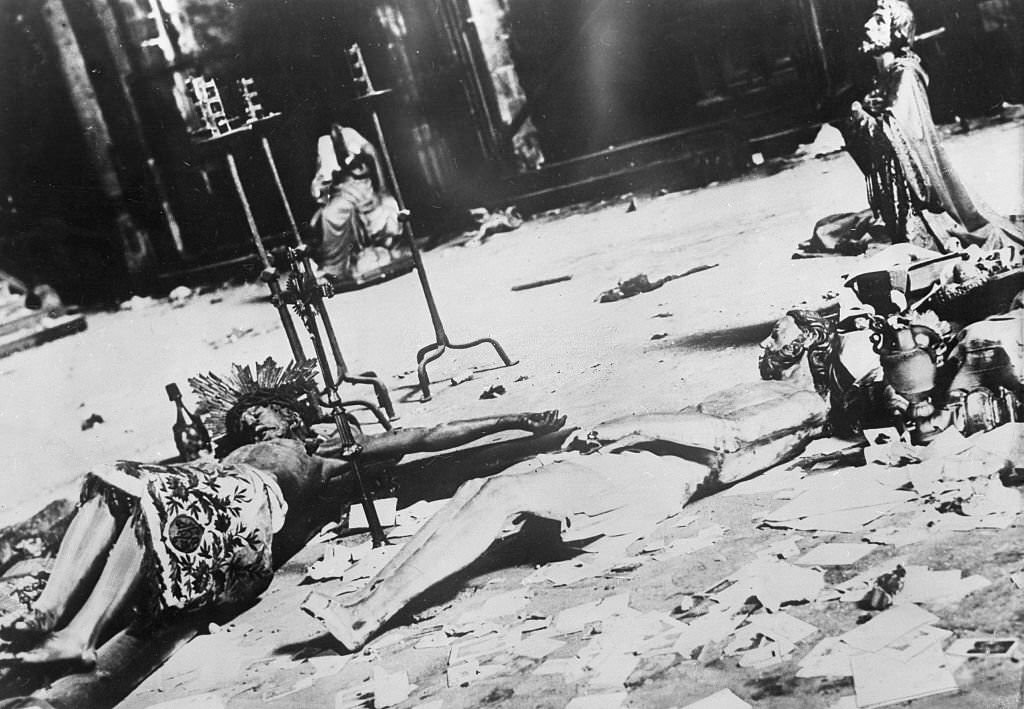
Jagged shards of tile and plaster carpet the nave, turning what should be a place of ordered ritual into a field of debris. On the ground lie toppled religious figures and broken church furnishings, their former prominence reduced to scattered fragments. The tilted camera angle heightens the sense of sudden rupture, as if the building itself has been knocked off balance by the violence of the moment.
The title places this scene in the first days after the outbreak of the Spanish Civil War, around July 20, 1936, when attacks on churches and religious imagery flared in parts of Republican-held Spain. Whatever the specific town, the photograph speaks to a wider pattern of anti-clerical unrest and retaliatory destruction that erupted alongside political upheaval. It also reminds us how quickly civic conflict can spill into sacred spaces, making symbols of faith targets in a struggle over power and identity.
For readers searching Spanish Civil War history, this image offers a stark entry point into the war’s cultural and religious front lines, not only its battlefields. The scattered statues and overturned objects act like a visual inventory of loss—artworks, devotional items, and community landmarks damaged in a matter of hours. Seen today, the devastated church stands as evidence of how the early days of 1936 reshaped everyday life, leaving ruins that photographers preserved when words were still failing to keep pace.