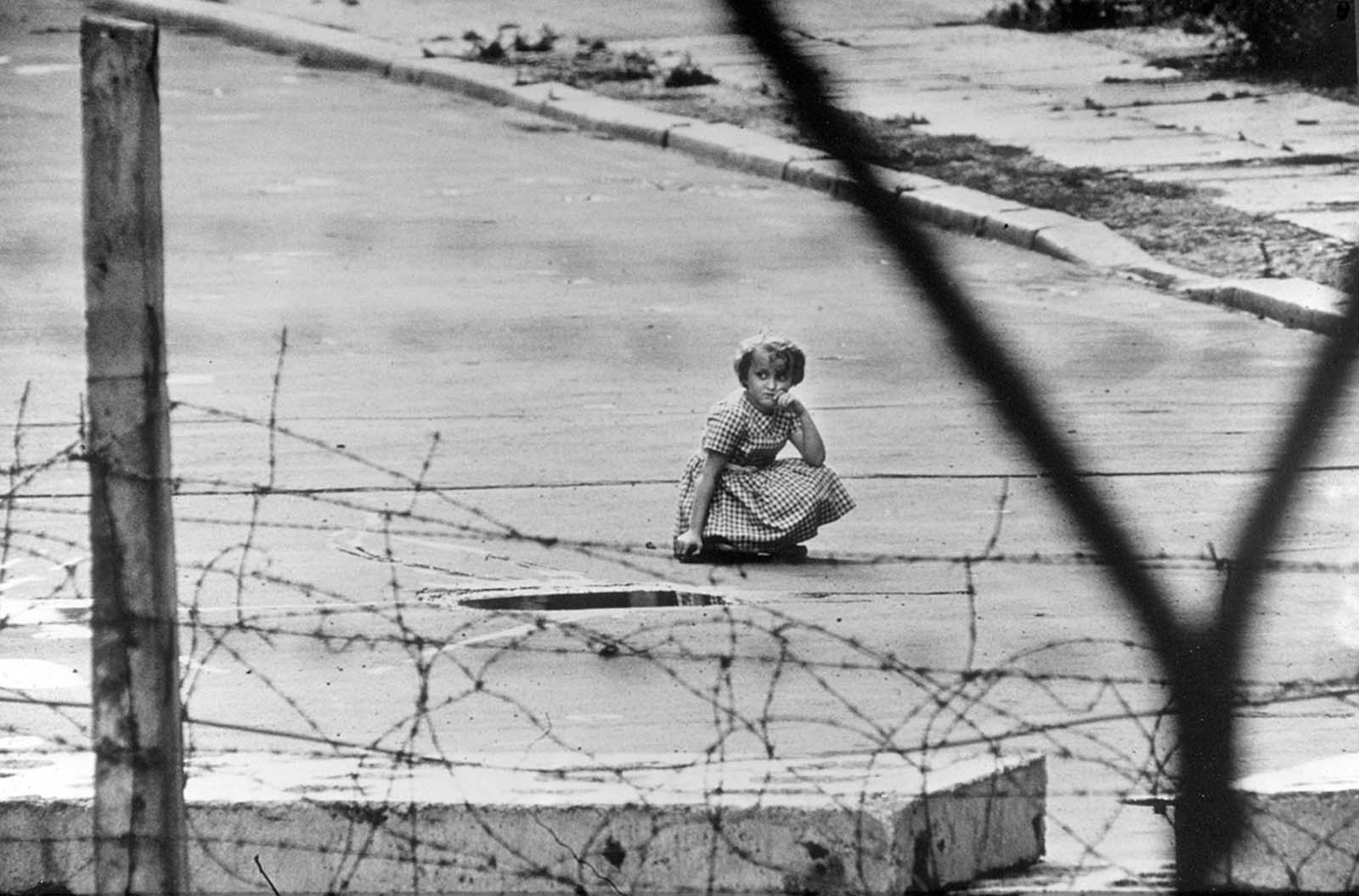
Barbed wire slices across the foreground like a warning scribbled over everyday life, while a lone child crouches on a broad, empty stretch of pavement. The pose suggests play, yet the stillness and the watchful glance toward the camera make it feel staged—an ordinary moment pressed into service as an argument. Even without showing the Berlin Wall itself, the obstacles and the void around her speak loudly about separation in Berlin, 1962.
East German authorities understood the power of appearances, and the title’s claim—children sent to the base of the Wall to “act as if they were at play”—reveals propaganda at the level of the street. The scene’s simplicity is its message: calm, normal, controlled. But the harsh geometry of concrete, the lack of other people, and the tangle of wire hint at the reality behind that performance during the Cold War’s tense early years.
Viewed today, the photograph becomes a quiet study of how borders reshape childhood and how governments choreograph public life. It’s a stark, SEO-relevant window into the history of the Berlin Wall, East Germany, and everyday experiences in divided Berlin, where innocence was often enlisted to soften the look of coercion. The image lingers because it refuses comfort—what should be a playground is instead a stage set against confinement.