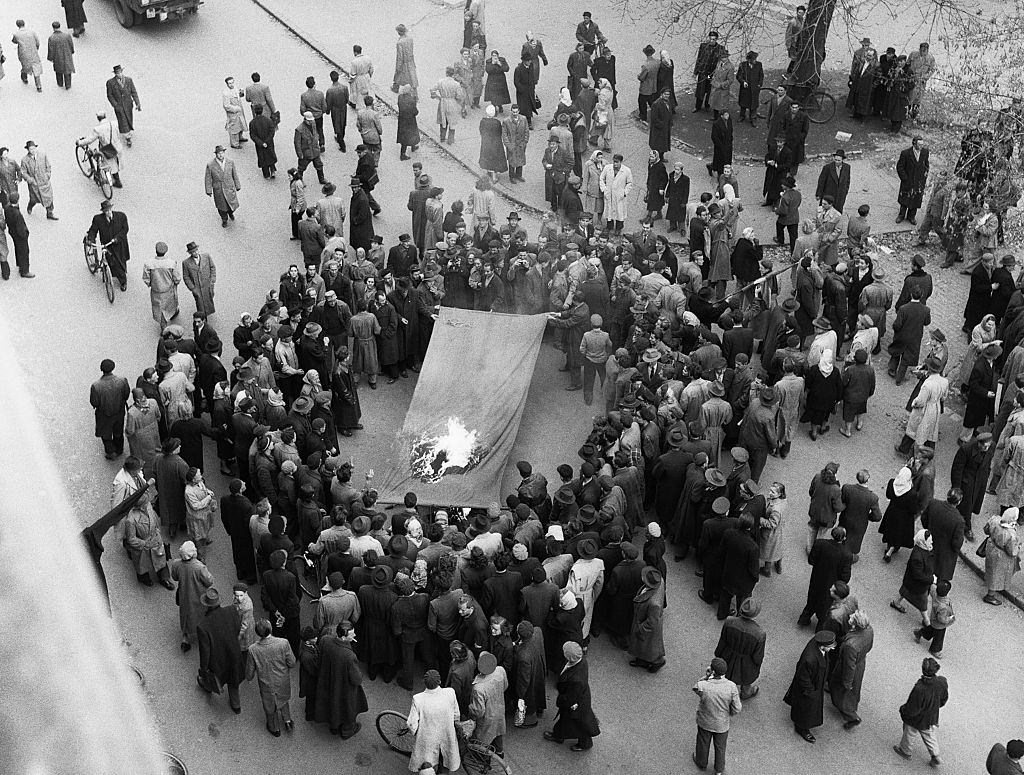
From an elevated vantage point, a dense crowd gathers in the street, forming a ring around a large flag laid flat on the pavement. A small blaze eats into the fabric near one corner, and a faint haze drifts upward as onlookers press close, hands in pockets and coats buttoned against the chill. Faces turn toward the burning cloth, while a few figures linger at the edges with bicycles and wary posture, as if unsure how quickly the moment might change.
The title, “Hungarian Revolutionaries burning Russian Flag, 1956,” frames the scene as more than a public spectacle; it reads like an act of defiance staged in full view of ordinary city life. What stands out is the mix of participants—men in brimmed hats, women in headscarves, pedestrians pausing mid-step—suggesting a movement that spilled beyond clandestine meetings into open streets. In the language of symbols, setting a flag alight is a blunt rejection of authority, a gesture meant to be witnessed and remembered.
Seen today, the photograph speaks to the tension of the Hungarian Revolution of 1956 and the wider story of Soviet influence in Eastern Europe. The crowd’s tight circle becomes a temporary forum where politics, anger, hope, and fear converge around a single burning emblem. For readers exploring civil wars, uprisings, and Cold War history, this image offers a stark, human-scale view of protest—one that captures the collective energy of a city confronting power with fire and resolve.