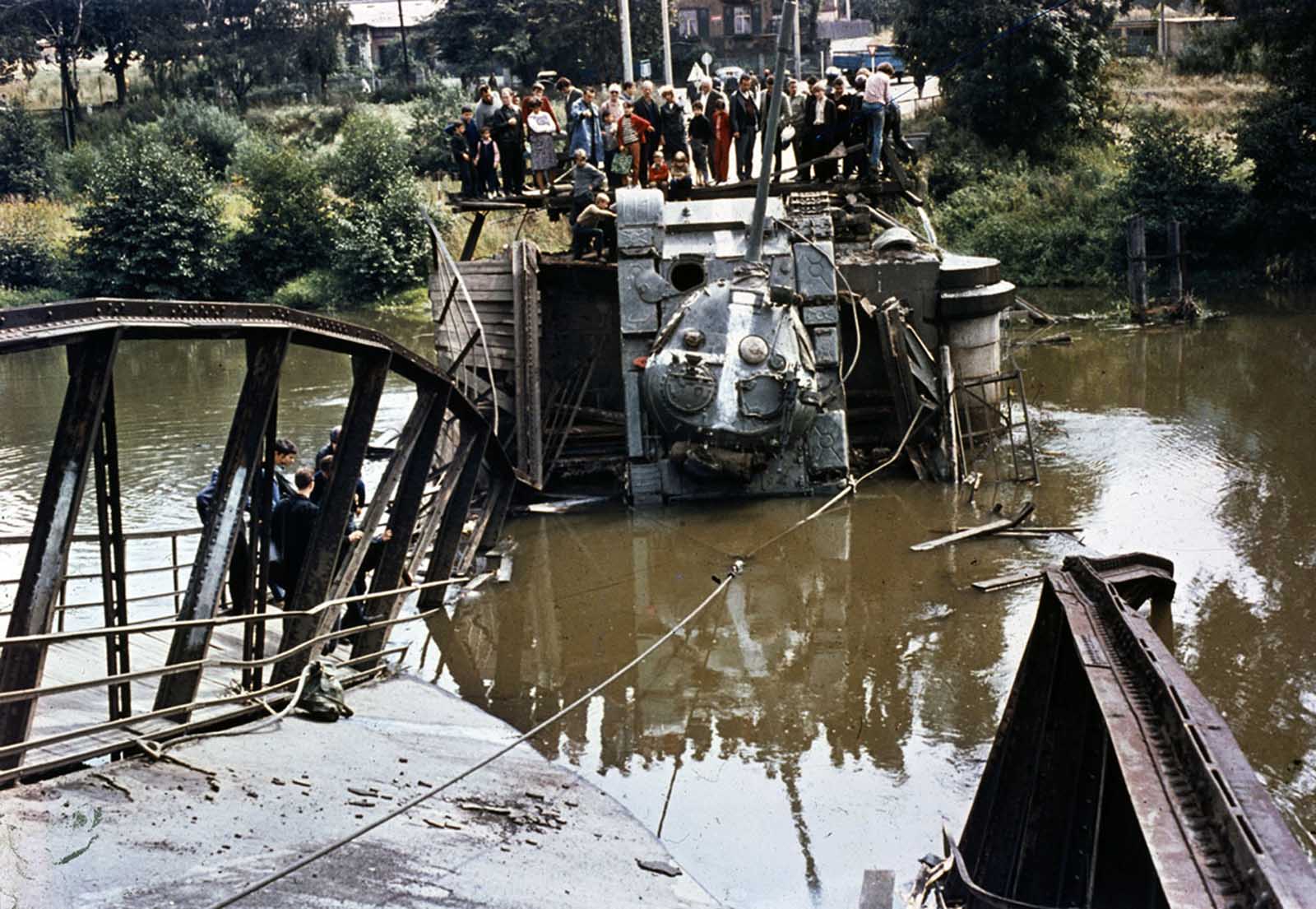
A crowd gathers at the river’s edge as a Soviet tank sits helplessly in the water, its front end wedged amid broken timbers and twisted metal where the bridge has failed. The scene is unusually vivid: civilians peer down from the remaining span while ropes and cables stretch across the muddy surface, suggesting hurried attempts to stabilize the wreck or prepare a recovery. Trees and modest buildings frame the background, grounding the moment in an ordinary townscape disrupted by sudden military weight and collapsing infrastructure.
Dated in the title to August 21, 1968, the photograph hints at the broader tension of armored movement through civilian spaces, when heavy vehicles and fragile crossings met with disastrous results. The tank’s turret and long gun barrel dominate the composition like a toppled monument, contrasting with the small figures above it who watch, point, and confer. It’s the kind of incident that turns grand geopolitical events into local calamity—blocked routes, damaged bridges, and stunned onlookers trying to make sense of what they’re witnessing.
For readers searching for Cold War history, Soviet tanks, or the 1968 invasion imagery, this historical photo offers a stark reminder that war’s machinery can be undone by something as mundane as a bridge giving way. Beyond the political headlines, the frame captures improvisation and curiosity: civilians clustering for a better view, the river swallowing debris, and the tank rendered “out of action” not by enemy fire but by gravity and structural failure. The result is a compelling snapshot of how quickly power can turn into predicament, and how public space becomes a stage for history in real time.