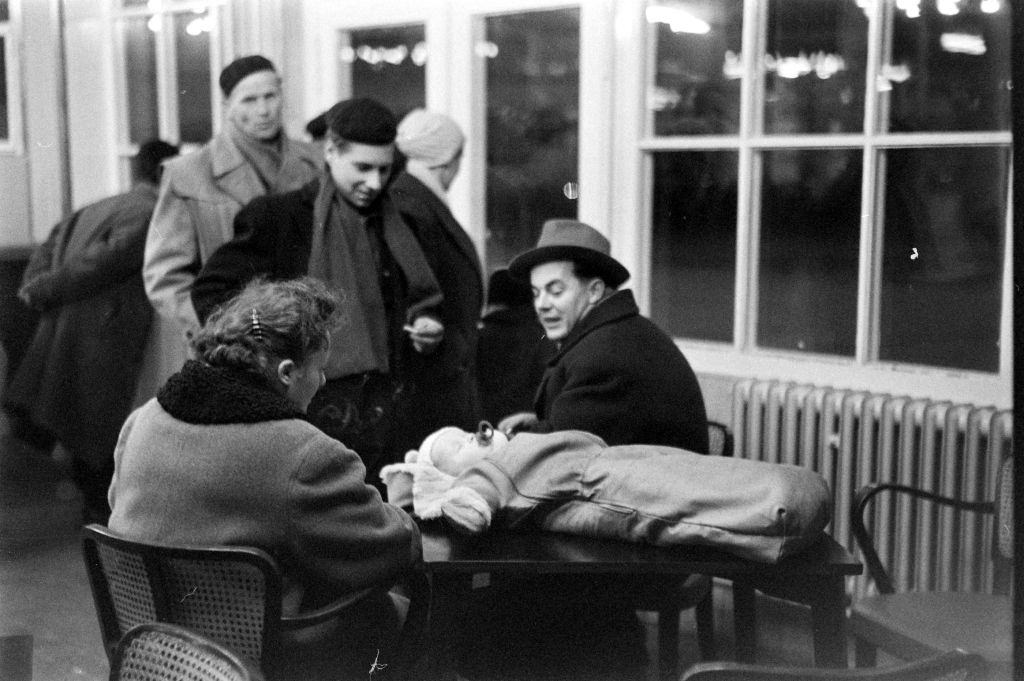
In a brightly lit interior that feels like a station hall or public waiting room, Hungarian refugees gather around a small table, their winter coats and hats still on as if departure could be called at any moment. A bundled child lies across the tabletop, asleep or simply exhausted, while adults lean in close—one seated, one standing—caught mid-conversation. The tall windows and bare radiator behind them frame a scene that is less about spectacle than about the ordinary logistics of survival.
The title points us to the Hungarian Revolution of 1956, a moment when political upheaval and violence pushed thousands into flight and forced relocation. Here, relocation is not an abstract policy but a lived experience: waiting, talking, watching over children, and exchanging the practical information that keeps families moving. The image’s quiet intimacy suggests how civil conflict reshapes daily life, turning public spaces into temporary homes and strangers into brief companions.
For readers searching for historical photos of the 1956 Hungarian Revolution, Hungarian refugees, and displacement during Cold War-era crises, this photograph offers a grounded, human-scale view. It reminds us that the story of revolution is also the story of corridors and benches, of hurried decisions made under fluorescent light, and of the fragile calm found in a shared room. Even without visible landmarks, the tension between motion and pause—between uncertainty and care—anchors the scene in the wider history of forced migration.