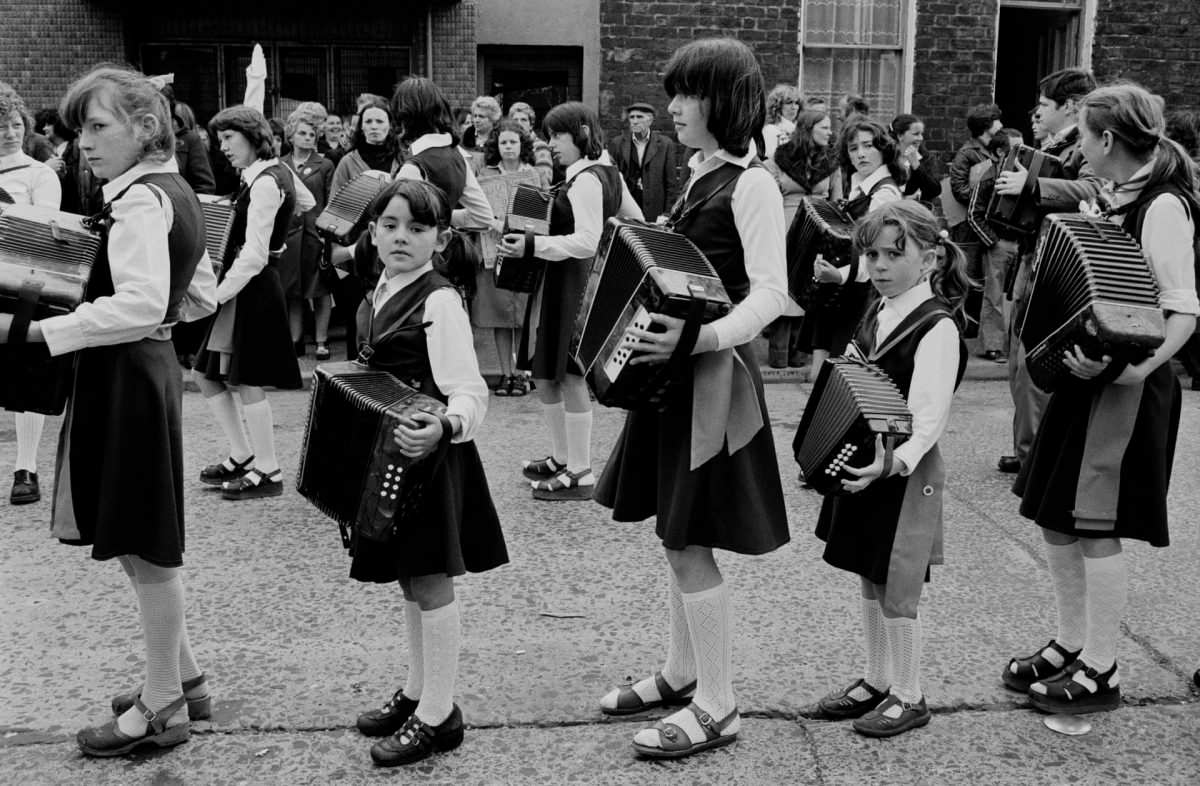
Rows of young musicians stand poised with accordions in hand, their matching uniforms and knee-high socks giving the street scene a disciplined, ceremonial rhythm. Some glance toward the camera while others look ahead, as if waiting for a signal to step off, and the crisp lines of their instruments echo the neat formation at their feet. Behind them, a tightly packed crowd fills the pavement in front of brick buildings and curtained windows, turning an ordinary roadway into a public stage.
Set in Derry, Northern Ireland, in 1978, the photograph reads as more than a simple marching band moment; it carries the undertone of a community gathering during a fraught era often summed up in the shorthand of civil conflict. The music itself is silent here, yet the sense of performance is loud—order, tradition, and youth presented together under watchful eyes. It’s a reminder that parades and bands could be expressions of identity as much as entertainment, especially when streets were sites of both celebration and tension.
What lingers is the mix of seriousness and childhood on the players’ faces, captured at the threshold between rehearsal and procession. The accordion band, the spectators, and the urban backdrop together make a richly detailed slice of late-1970s life in Derry, ideal for readers searching for Northern Ireland history, The Troubles-era street scenes, and the lived texture of local culture. In a single frame, the photograph preserves how communities assembled, watched, and listened—even when the wider world felt anything but steady.