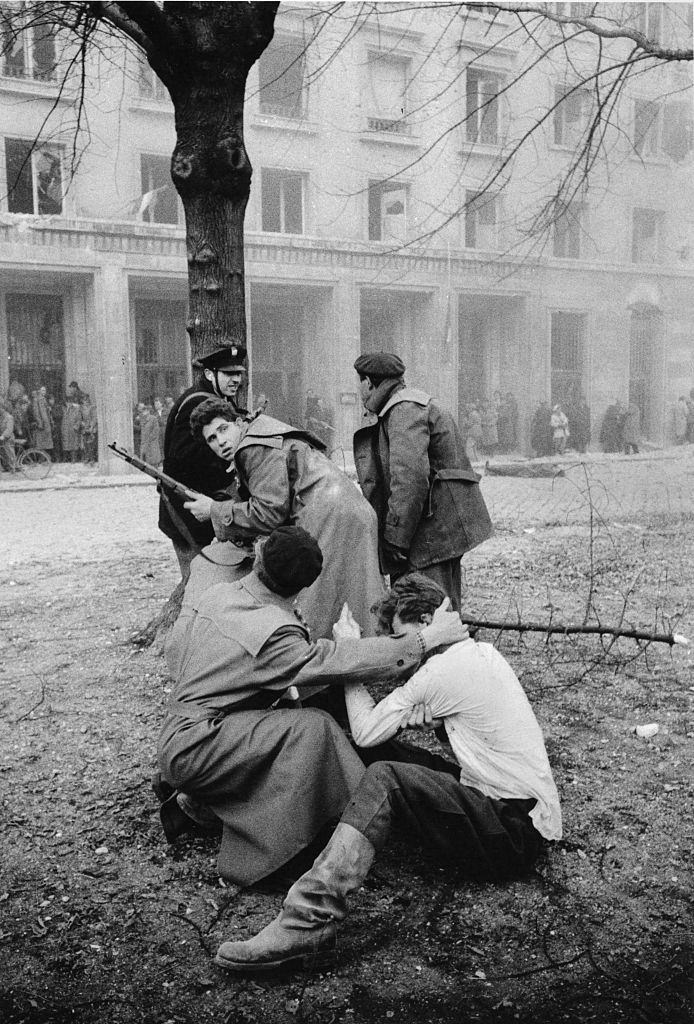
Tension hangs in the cold air of Budapest on October 30, 1956, as armed men cluster near a bare tree and a detained figure sits on the ground, hands raised in a defensive gesture. Faces turn toward the camera with a mix of alarm and resolve, while the architecture behind them—arched colonnades and tall windows—frames the scene like a stage where the revolution’s violence has spilled into public view. The title identifies the captive as a member of the Hungarian secret police (ÁVH), a symbol of state repression whose sudden vulnerability helps explain the fury of the crowd.
Dust, smoke, or winter haze softens the background, yet the foreground is sharp with urgency: rifles are held close, bodies lean inward, and one man appears to restrain or steady the prisoner at close range. The crowd in the distance watches from the shelter of the building’s arcade, creating a layered perspective that emphasizes how quickly order disintegrates during civil unrest. This is not battlefield distance but street-level proximity—an encounter shaped by fear, retaliation, and the collapse of authority.
For readers tracing the Hungarian Revolution of 1956, the photograph offers a stark entry point into the days when Budapest became the epicenter of a nationwide uprising. It speaks to the cycle common to civil wars and revolts: institutions built on coercion can, in a moment, become targets, and individual lives are caught in the turn of the tide. As a historical document, it invites careful viewing—of uniforms and gestures, of bystanders and setting—while reminding us that behind every political label were people facing irreversible choices.