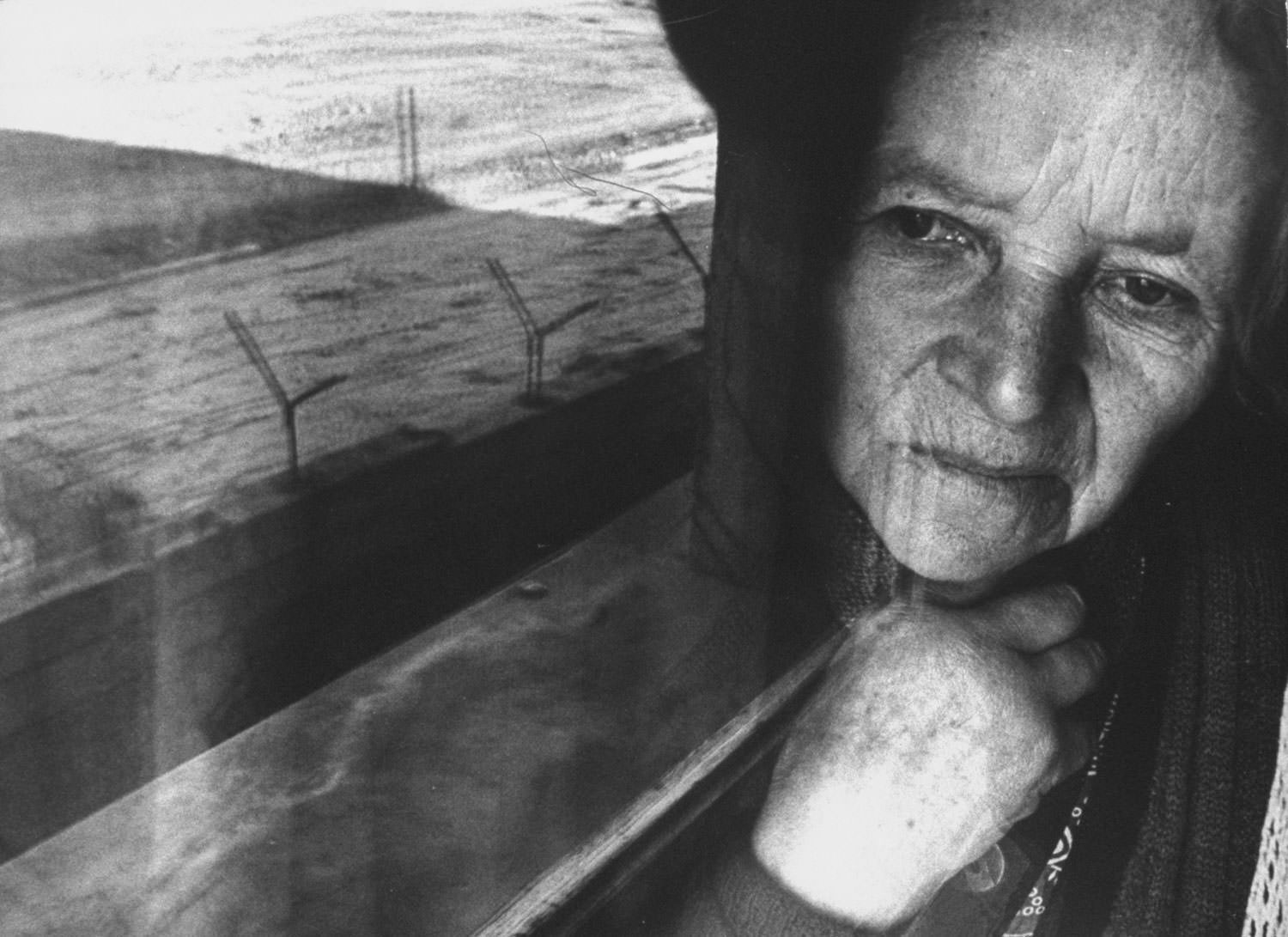
Pressed close to the glass, a West Berlin woman stares outward while the Berlin Wall and its harsh line of fencing appear as a reflection across her window. The composition lets two worlds occupy the same frame—her face in the foreground, and the newly enforced border hovering like a shadow over her everyday view. Fine wrinkles, a furrowed brow, and a hand drawn up under her chin suggest the weight of private thought at a very public fracture.
In 1961, the barrier that sliced through Berlin was more than concrete and wire; it was a sudden reordering of routines, relationships, and the mental map of a city. The reflected barricade reads almost like an intrusion, as if history has entered the room uninvited and settled on the panes. Instead of dramatizing the checkpoint or the guard tower, the photographer centers the quieter truth of the Cold War in Berlin: separation experienced at home, one look at a time.
For readers searching for Berlin Wall history, West Berlin life, or early Cold War photography, this image distills the era’s tension into a single, intimate moment. The woman’s gaze does not chase spectacle; it holds steady, as though measuring what has been lost and what might still be endured. Reflection becomes the story’s key device—showing how a divided city could turn even a window into a frontier.