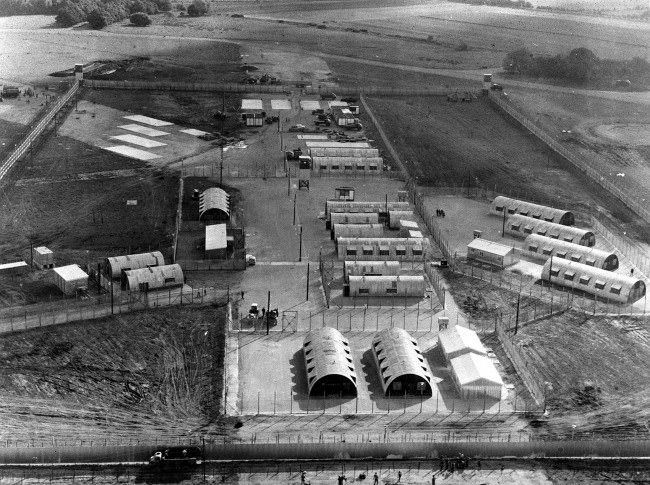
From above, the site reads like a map of improvisation: fenced rectangles, gravel lanes, and ranks of hutments set down on an expanse that still feels like open airfield. The perimeter line and sparse buildings emphasize how much of the surrounding land remains bare, a reminder that this was once designed for aircraft movement rather than confinement. Even in this distant view, the orderly geometry of the compound suggests a place engineered for control, surveillance, and routine.
Long Kesh, as the title notes, stands at a stark crossroads of 20th-century conflict—built first for war in the skies and later repurposed for war at home. An airfield that once launched bombers toward Germany becomes an internment camp for IRA detainees, and the contrast is hard to miss: runways and dispersal space traded for wire, gates, and clustered accommodation blocks. The modern additions mentioned—central heating and other amenities—sit uneasily beside the hard logic of detention, hinting at an attempt to normalize an extraordinary policy.
Civil wars are rarely confined to battlefields, and this photograph underlines that truth by showing how ordinary landscapes get rewritten by emergency measures. The aerial perspective invites readers to consider not only the buildings but the choices that produced them: which spaces are fenced, which routes are controlled, and how quickly infrastructure can be adapted to new purposes. For anyone exploring the history of internment, the Northern Ireland conflict, or the transformation of wartime sites, this image offers a sobering, SEO-friendly window into Long Kesh’s layered past.