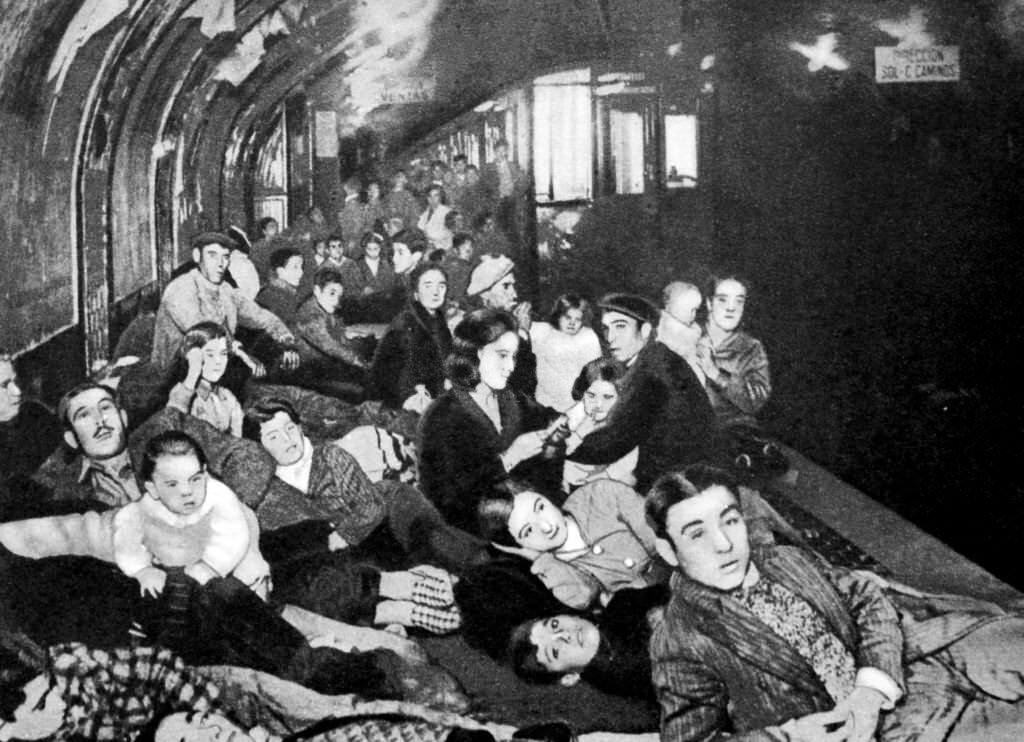
Deep beneath Madrid’s streets, a metro platform becomes an improvised dormitory as civilians stretch out shoulder to shoulder, bundled in coats and blankets. Men, women, and children occupy every available patch of floor, some trying to rest, others staring toward the camera with the guarded alertness of people waiting for the next sound from above. The curved tunnel walls and the dim, artificial lighting make the station feel both protective and claustrophobic, a shelter that offers safety but not comfort.
Along the platform edge, the stopped train and its lit windows hint at a city whose daily rhythms have been interrupted rather than erased. Faces are close, personal belongings minimal, and the posture of many—half-reclining, half-ready to move—suggests how fragile this pause really is. In the context of the Spanish Civil War, the Madrid Metro served not only as transport but as a refuge, turning modern infrastructure into a communal lifeline during moments of danger.
What lingers most is the ordinary texture of survival: families huddling together, strangers sharing space, and the quiet negotiation of endurance in public view. The photo titled “Civilians take shelter in a Metro station in Madrid, 1938” offers a stark, SEO-relevant window into wartime Madrid, civilian life in the Spanish Civil War, and the history of air-raid shelters in urban Europe. It reminds us that conflict is often recorded not just on battlefields, but in the crowded in-between places where people wait, listen, and try to sleep.