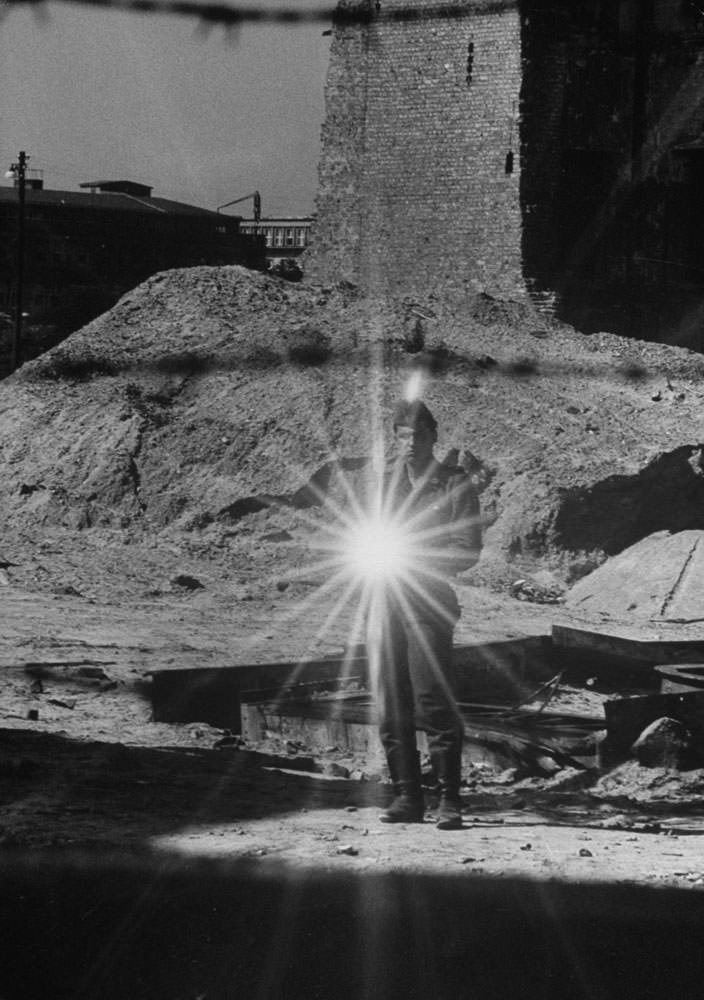
A hard burst of reflected sunlight erupts at the center of the frame, turning an ordinary hand mirror into a defensive weapon. Behind the glare, an East German policeman stands amid rough ground and rubble, his figure partially swallowed by the star-shaped flare that would have dazzled any lens pointed his way. The surrounding ruins and raw earth hint at a cityscape being reshaped in haste, where the act of looking—and recording—had suddenly become contentious.
August 1961 sits heavy in the background of this scene, a moment when borders tightened and cameras became instruments of scrutiny as much as documentation. Rather than confiscating equipment or blocking the view with bodies, the officer uses the physics of light to interrupt the photographer’s attempt, a small improvisation that speaks volumes about control, secrecy, and the struggle over images. The technique is simple, but its message is blunt: some sights were not meant to circulate.
For readers searching Cold War history, East Germany, and the early days of the Berlin Wall era, this photograph offers a striking lesson in how power met the press on the street. It’s not only a record of a policeman and a mirror; it’s a visual metaphor for obfuscation, where truth is present yet forced into glare. Even in stillness, the picture crackles with tension—between witness and authority, between documentation and denial, and between a city’s changing landscape and the people trying to preserve it on film.