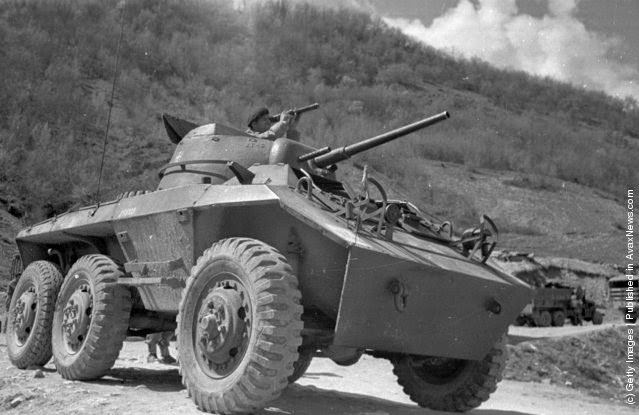
Perched high on the turret, a Greek soldier scans the rugged mountainside while his armored vehicle waits on a rough track below. The angle emphasizes the machine’s bulk—thick tires, sloped armor, and a forward-pointing gun—set against steep, scrubby hills that feel both protective and exposed. In a single glance, the scene conveys vigilance: eyes up, terrain read, routes judged, and every ridge treated as a potential threat.
The Greek Civil War in 1948 was fought as much by geography as by ideology, and photographs like this underline how decisive the mountains could be. Armored vehicles brought mobility and firepower, yet the uneven ground and narrow approaches demanded caution, coordination, and constant observation. The soldier’s posture—half lookout, half commander—suggests the tense routine of patrols and positional warfare where the landscape determined what was possible.
For readers exploring Greek Civil War history, this image offers a stark reminder of how modern weapons met ancient terrain. Dusty roads, distant vehicles, and an open sky frame a moment that feels quiet, but not calm—a pause measured in seconds rather than relief. As a historical photo, it speaks to the lived experience of conflict: endurance, alertness, and the uneasy stillness before the next move.