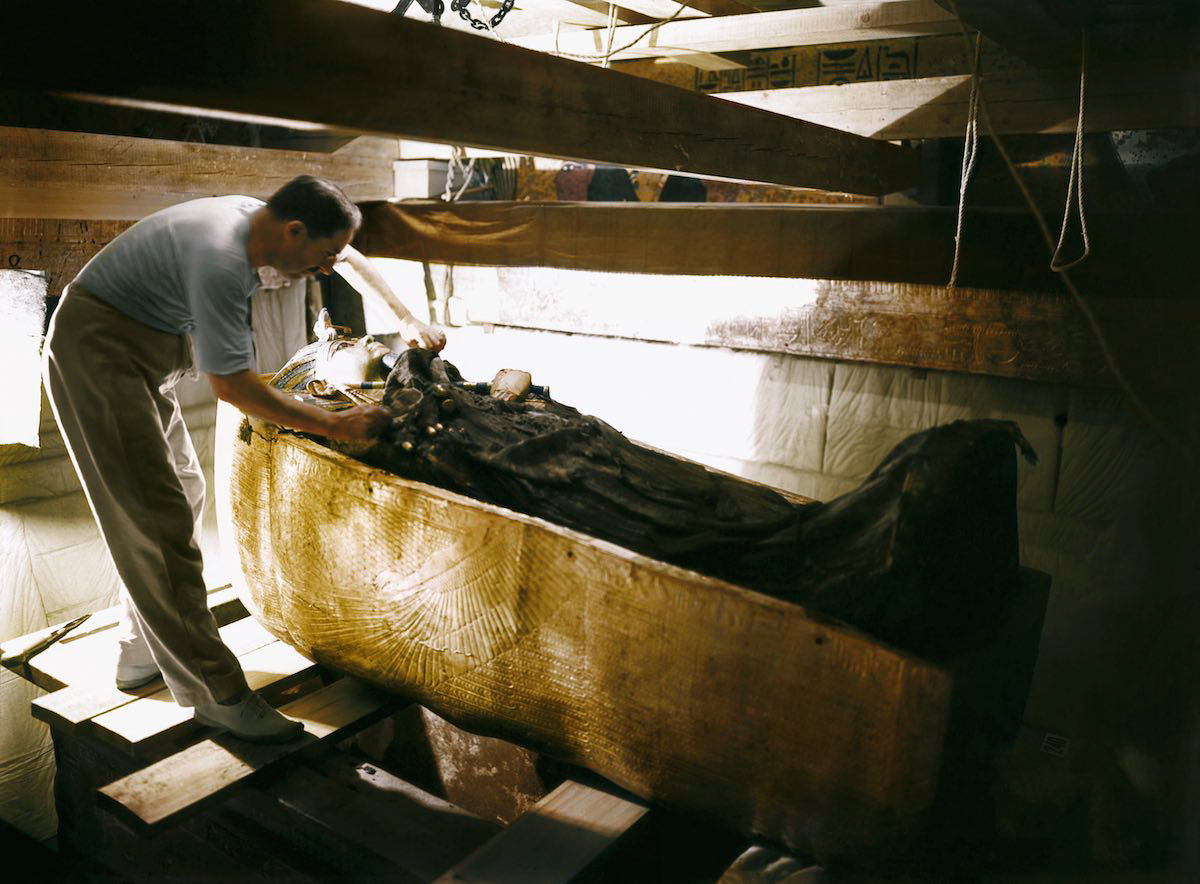
Leaning over the gilded contours of a nested coffin, Howard Carter appears absorbed in the careful, physical work of discovery—hands close to the lid, posture tense with concentration. The colorization brings out the warm sheen of gold against the dim, workshop-like atmosphere of the Burial Chamber, where heavy beams and rigging hover overhead. Light pools across the coffin’s surface, catching carved lines and subtle textures that hint at the craftsmanship and ritual purpose of this extraordinary burial.
October 1925 places the scene well into the painstaking phase of excavation and conservation in Tutankhamun’s Tomb, when progress depended on patience more than spectacle. The second (middle) coffin remains within the first (outermost) case, underscoring how layered—and how fragile—the task was: separating centuries-old materials without damaging what they protected. What reads at first as an iconic moment in Egyptology is also a reminder of the practical realities on the ground, with makeshift platforms, cloths, and supports turning the chamber into a temporary laboratory.
For readers drawn to ancient Egypt, Tutankhamun, and the history of archaeology, this photograph offers more than a famous name—it conveys scale, intimacy, and the controlled chaos of a major excavation. The contrast between modern clothing and ancient gold heightens the sense of crossing eras, while the enclosed space suggests how little room there was for error. As an SEO-friendly window into Carter’s work on Tutankhamun’s coffins, it captures the delicate threshold between uncovering the past and preserving it for the future.