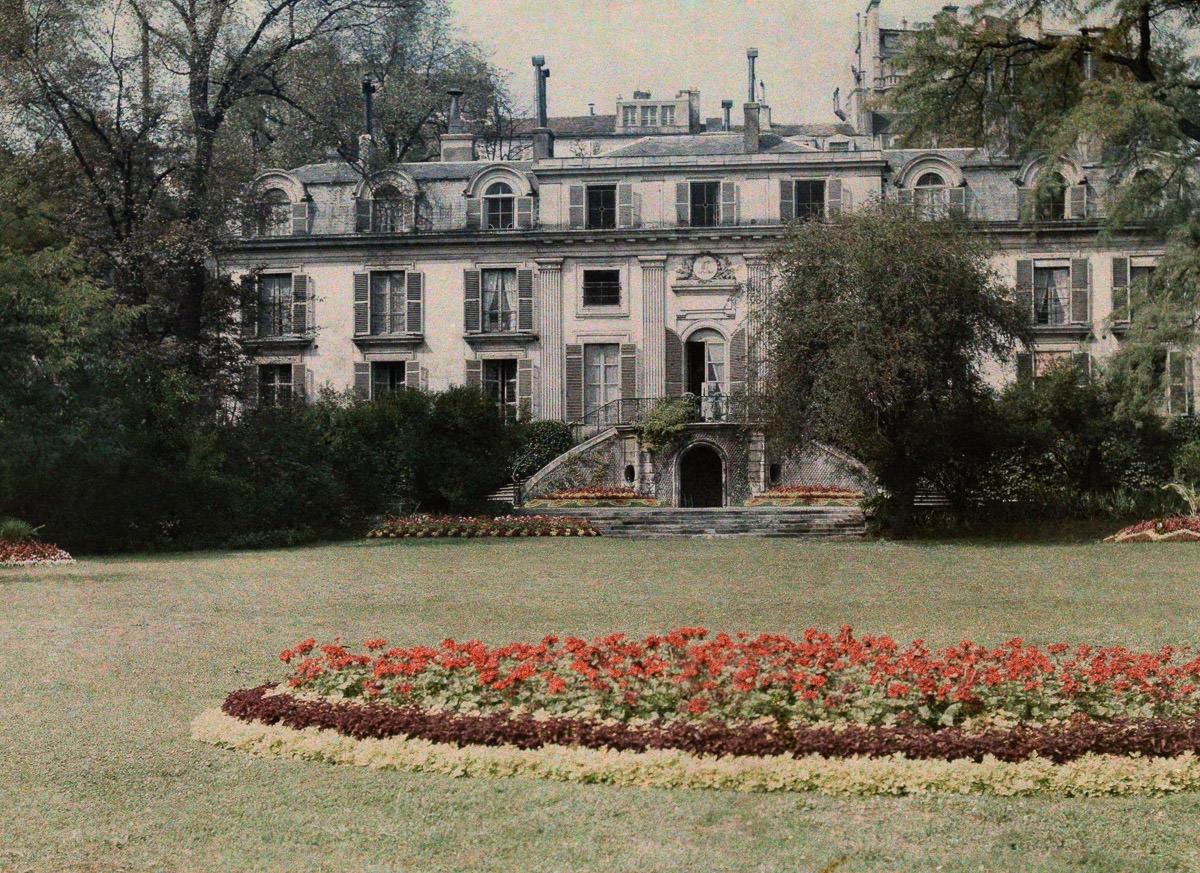
Behind a broad sweep of lawn and carefully edged flowerbeds, a pale Parisian mansion rises with the quiet confidence of early 20th-century taste. The façade is orderly yet elegant—tall windows, shuttered openings, and arched dormers tucked into the roofline—while a central doorway and curved stone stairway draw the eye toward the building’s heart. Mature trees and dense shrubbery frame the scene, softening the architecture and giving the garden a secluded, almost private-park feel.
Colorization brings out details that are easy to miss in monochrome: the muted greens of the grounds, the warm stone of the steps, and the bright reds and creams of the formal planting that anchors the foreground. The composition feels deliberate and symmetrical, like a postcard meant to sell the romance of Paris through calm geometry and cultivated nature. Even without visible crowds or traffic, the setting suggests a city where grand residences and public gardens could coexist just beyond the bustle.
Viewed as “Paris, 1920s,” the photograph offers a glimpse into the period’s balance between tradition and modern life—old-world façades maintained, gardens trimmed, and urban space arranged for leisure as much as display. For readers searching for Paris 1920s photos or historical Paris colorization, this image speaks through atmosphere rather than landmarks, evoking an era in tones of stone, leaf, and flower. It’s a gentle reminder that history often survives not only in famous streets, but in the quieter corners where a staircase meets the lawn and the season’s blooms mark time.