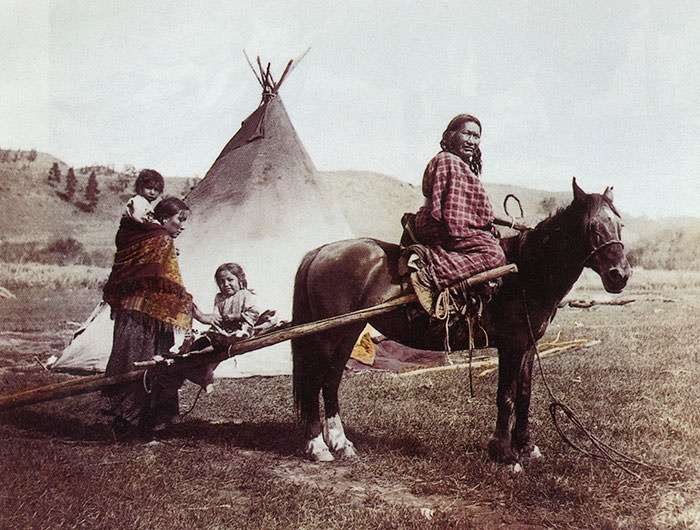
Strong Left Hand sits tall on horseback, turning toward the camera with a steady, composed gaze, while his family gathers close beside a travois stretched behind the horse. A tipi rises in the background, its poles reaching into the pale sky, and the open grassland and distant hills suggest the wide, windswept space of the Northern Cheyenne Reservation. The colorization brings warmth to the scene—plaid cloth, earth tones, and weathered leather—inviting a more immediate connection to a moment often kept at arm’s length by time.
Around the horse, everyday movement and family life come into focus: an adult wrapped in a patterned blanket holds a child, while another small figure sits near the travois as if mid-journey or paused between tasks. The arrangement of ropes and poles, the practical layering of clothing, and the calm stance of the animal all point to lived experience rather than staged spectacle. Rather than offering grand ceremony, the photograph lingers on the ordinary logistics of care, travel, and belonging.
Taken in 1906 by Julia Tuell, the image reads as both documentation and encounter, shaped by the complicated realities of reservation life in the early twentieth century. For readers interested in Northern Cheyenne history, Indigenous family portraits, and the material culture of the Plains, this photograph provides details worth revisiting—how people dressed, what they carried, and how they moved across their landscape. The added color underscores texture and presence, helping modern viewers see the scene not as distant “history,” but as a family moment anchored in a specific place and time.