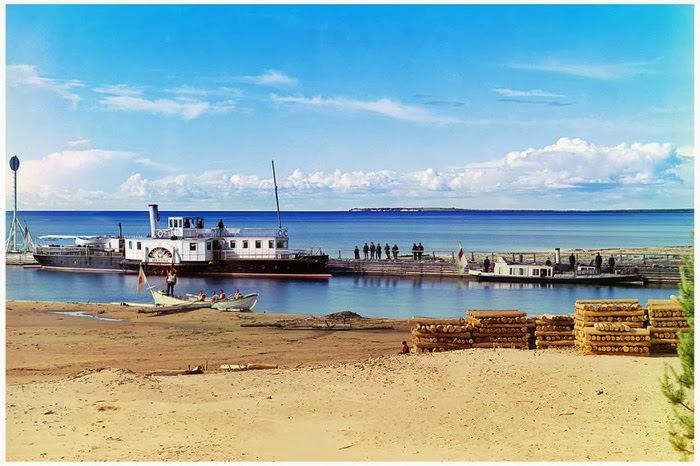
Soft blue water and an open, cloud-dappled sky frame a working shoreline as a Russian Empire ship sits close to the sandy edge, its dark hull and pale superstructure standing out in the colorization. A small boat glides in the foreground while figures gather along the pier, turning the scene into a snapshot of everyday maritime life rather than a staged naval portrait. Even without a clearly marked harbor name, the calm horizon and low land in the distance suggest a sheltered route where coastal traffic mattered as much as the great sea lanes.
Along the vessel’s deckline, the practical details of early 20th-century shipping come through—compact cabins, railings, rigging, and the unmistakable silhouette of a steam-era workhorse built to move people and goods efficiently. On shore, neatly stacked bundles hint at cargo waiting its turn, reminding viewers that ships like this were the connective tissue of an empire: bringing supplies in, carrying exports out, and stitching remote communities into larger markets. The onlookers clustered near the gangway add scale and quiet drama, as if a departure or arrival has briefly made this waterfront the center of local attention.
Colorization gives the 1909 moment a surprising immediacy, letting the scene read less like distant history and more like a living afternoon by the water. The muted tones of sand and timber, the reflective surface of the harbor, and the ship’s crisp contrasts help modern eyes pick out textures that monochrome often flattens. For anyone searching Russian Empire ship history, early 1900s maritime transport, or restored historical photos, this image offers a grounded glimpse of how travel, trade, and routine labor looked on the imperial waterfront.