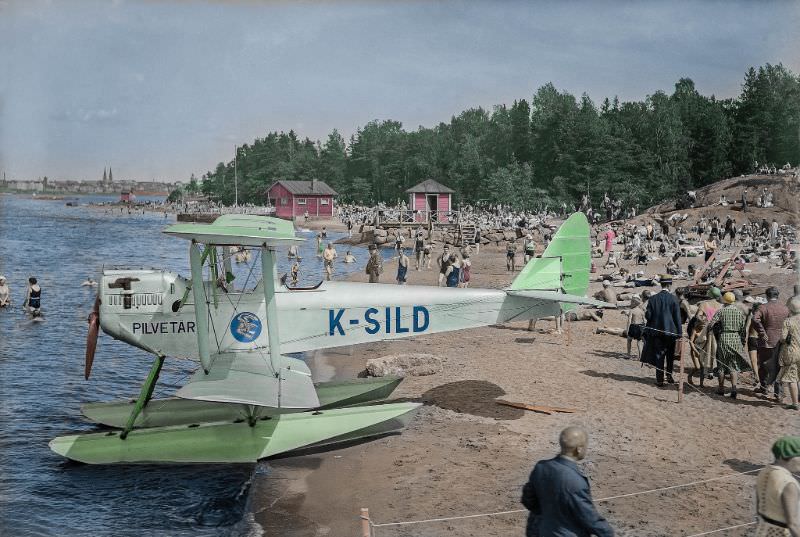
Past the bustle of a summer shoreline in Helsinki, the de Havilland D.H.60X “Pilvetär” rests at the water’s edge on its floats, its pale fuselage and green-tinted surfaces standing out against the dark Baltic shallows. The registration K‑SILD is clearly painted along the side, while “PILVETÄR” appears near the nose, giving the aircraft a personality beyond metal and fabric. Colorization brings an immediacy to the scene: wet sand, rippling water, and the soft northern light that makes the whole moment feel close enough to touch.
More than an aviation portrait, the photograph reads like a slice of city life, with crowds gathered along the beach and people wading near the aircraft as if it were part of the day’s entertainment. The little floatplane sits low and ready, its propeller poised at the front and its wings casting clean lines over the shore, a reminder of how compact early light aircraft could be. Seaplanes like this bridged land and sea, making harbors and beaches into informal airfields and turning waterfronts into gateways for modern travel.
In 1931, the presence of “Pilvetär” in Helsinki speaks to an era when flight still carried a sense of spectacle and possibility, drawing onlookers as readily as it carried passengers. The mix of aviation technology and everyday leisure—swimmers, strollers, and spectators—underscores how quickly airplanes became part of the public imagination. For readers interested in Finnish aviation history, De Havilland aircraft, or the atmosphere of interwar Helsinki, this colorized view offers a vivid window into a shoreline where the future briefly anchored.