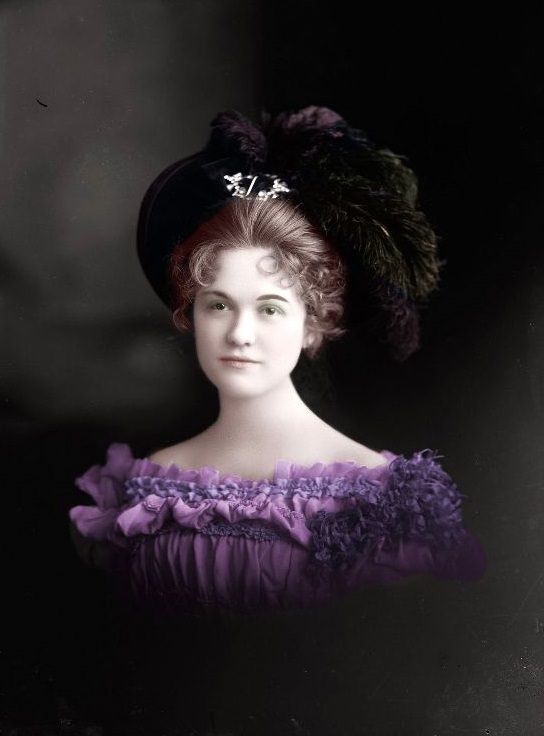
Louise Jackson appears in a carefully posed studio portrait, her gaze steady and composed against a soft, dark backdrop. The colorization brings gentle life to her features—warm skin tones, delicately styled hair, and the subtle contrast that photographers of the era prized for creating depth without distraction. Even without a visible setting, the image carries the quiet formality of a professional sitting meant to be kept, shared, and remembered.
Her fashion choices speak volumes: an off-the-shoulder dress in a rich violet hue with gathered trim, paired with a dramatic hat crowned by dark feathers and a bright accent at the band. These details point to an age when portraiture doubled as a statement of taste, confidence, and social presentation. The careful arrangement of fabric and the soft lighting suggest an intent to convey refinement as much as likeness.
As a historical photo restoration, this colorized portrait invites closer attention to textures and mood that monochrome can flatten—the sheen of the hat, the layered ruffles, the natural blush of the face. For readers searching family history inspiration, early studio photography, or vintage fashion details, “Louise Jackson” offers a striking example of how colorization can renew a past moment without rewriting it. The result feels intimate and immediate, as if the distance of time has been gently narrowed.