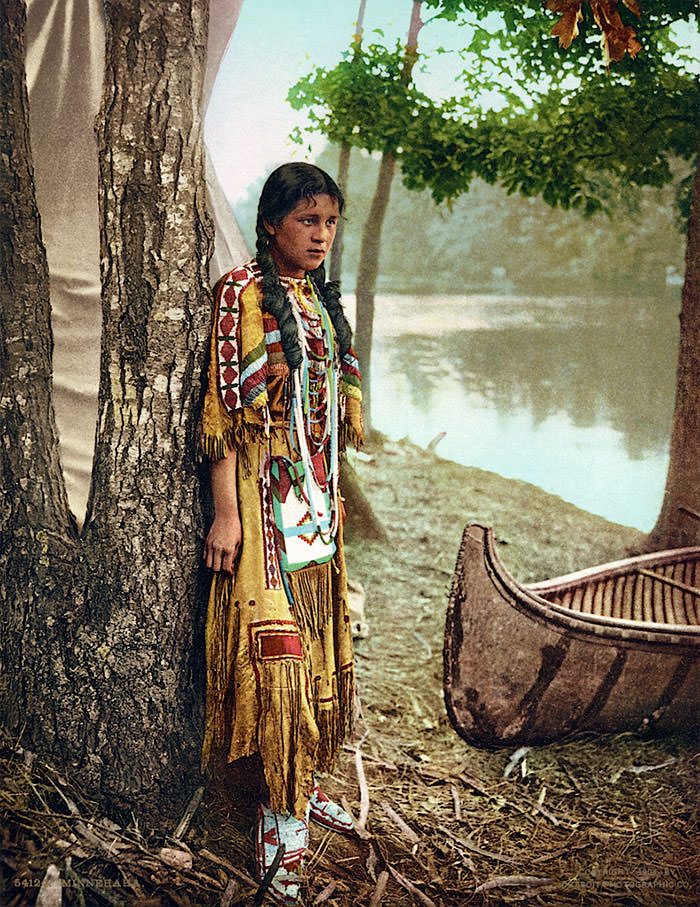
Leaning against a broad tree trunk at the water’s edge, a young figure stands in richly detailed attire—fringed buckskin, patterned beadwork, and layered adornments that draw the eye immediately. The colorization brings out warm ochres and reds against the cool greens of foliage and the pale, still surface of the river, turning a posed moment into something that feels close and present. Off to the right, a canoe rests on the bank, a quiet but powerful reminder of travel and daily life tied to the shoreline.
The title “Minnehaha. 1904” places this portrait in the early twentieth century, when studio practices and postcard-style scenes often blended ethnographic curiosity with romantic ideas about the American past. Here, the careful composition—tree as a backdrop, water as depth, canoe as symbol—suggests a deliberate attempt to evoke an “old-world” wilderness narrative even as modern America was rapidly changing. The subject’s steady gaze adds gravity, resisting the image’s staged calm and inviting a more thoughtful reading than simple nostalgia.
As a historical photo colorization, this piece is especially compelling for how it bridges eras: the original photograph’s intent and the modern effort to restore lifelike tones meet in a single frame. Viewers searching for Minnehaha 1904, early colorized photography, Native-style regalia in historic portraits, or river-and-canoe Americana will find plenty to study in the textures, patterns, and setting. Spend a moment with the details—the beaded geometries, the fringe, the grounded stance—and the photograph begins to feel less like a souvenir and more like an encounter preserved.