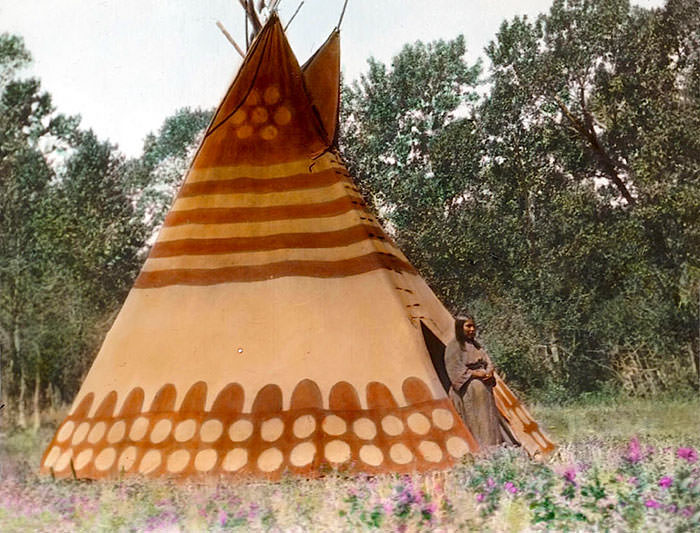
Rising from a meadow edged with summer wildflowers, the Thunder Tipi of Brings-down-the-sun anchors this Blackfoot camp scene with a bold, graphic presence. The painted cover—bands, dots, and scalloped forms—turns the lodge into both shelter and statement, the kind of design meant to be seen from across open ground. Behind it, a wall of leafy trees frames the camp in soft greens, giving the tipi’s warm tones even more strength.
A lone figure stands at the entrance, drawing the eye to the human scale of the structure and the quiet intimacy of camp life. The doorway flap and upright poles are clearly defined, and the tall silhouette of the lodge suggests a careful balance of function and ceremony. Details like these make the image especially valuable for readers searching for early 1900s Indigenous history, Blackfoot material culture, and traditional Plains housing.
Created as a glass lantern slide and later presented in colorization, the photograph carries the look of an era when travel images were projected for audiences hungry for glimpses of the West. That format emphasizes contrast and clarity, preserving the tipi’s painted motifs and the surrounding landscape as a vivid historical record. For anyone exploring Blackfoot camp photographs, Thunder Tipi symbolism, or early 20th-century visual documentation, this post offers a compelling window into the period without flattening it into mere nostalgia.