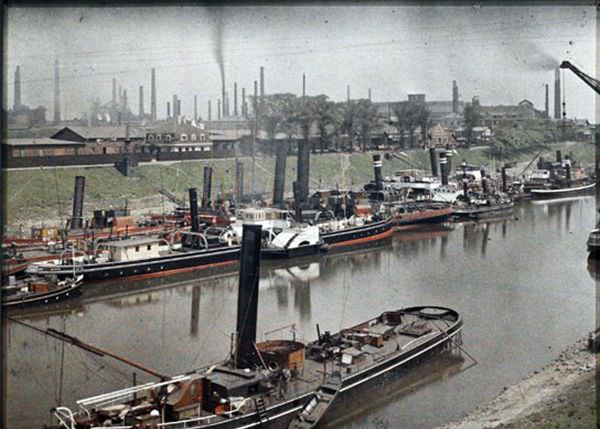
Along a broad German river in the 1900s, a line of steam-powered vessels sits moored shoulder to shoulder, their dark hulls and pale superstructures mirrored in still water. Tall funnels punctuate the scene, and the colorization brings out muted reds and blues that hint at painted trim, company markings, and the everyday practicality of working boats. In the foreground, a smaller craft and dockside equipment suggest constant loading, unloading, and repairs just out of frame.
Across the riverbank, an industrial skyline rises in dense layers: chimneys, smokestacks, and factory roofs stretching into a haze that softens the horizon. The landscape feels engineered—embankments, yards, and buildings arranged for production and transport—capturing the close marriage between waterways and heavy industry in early twentieth-century Germany. Smoke drifting upward acts like a visual timestamp of the era, when coal-fired power drove both manufacturing and the river traffic that fed it.
Colorized historical photos like this one do more than add pigment; they restore a sense of immediacy to a world often kept at arm’s length by grayscale. The scene speaks to commerce and modernity, but also to the rhythms of labor: crews maintaining boilers, port workers coordinating cargo, and townspeople living under a canopy of soot and steam. For anyone exploring German history, industrial heritage, or vintage river transport, this image offers a textured glimpse of how a working waterfront looked and felt in the 1900s.