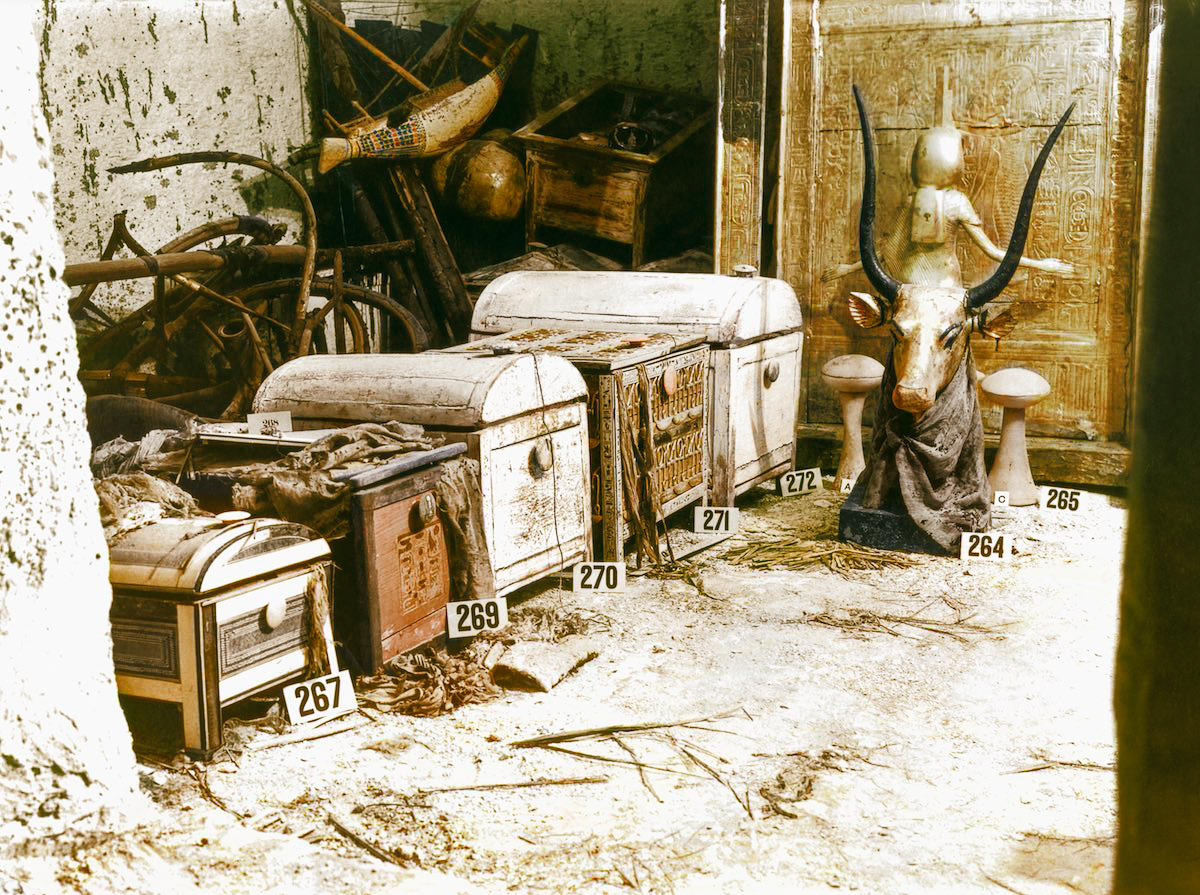
Running down the centre of the Treasury, a procession of storage chests forms an orderly corridor through the clutter of Tutankhamun’s Tomb, recorded in October 1926. Each box sits on the dusty floor with a numbered label—part of the meticulous cataloguing system used during the excavation—turning a chaotic hoard into a readable archive. The colorization brings out the warmth of aged wood and painted surfaces, making the scene feel newly immediate while preserving its documentary weight.
Along the left edge, overlapping shapes of dismantled equipment and objects create a dense backdrop, while the line of chests draws the eye forward like a measured path. On the right, a shrine-like panel crowded with hieroglyphs anchors the space, and nearby rests a striking bovine head with sweeping horns, set among other ritual items. The contrast between straight, practical boxes and the sculptural sacred forms hints at the Treasury’s dual nature: part storeroom, part ceremonial repository.
Near the end of this central alignment stands the canopic chest, identified in the title as Carter no. 266, underscoring how carefully every artifact was logged and tracked. Details such as scuffed surfaces, scattered reeds, and uneven stone walls evoke the conditions of early 20th-century archaeological work inside a sealed royal tomb. For readers searching for Tutankhamun’s Tomb photos, the Treasury chamber, or Howard Carter’s catalog numbers, this image offers a vivid, grounded glimpse of discovery translated into order.