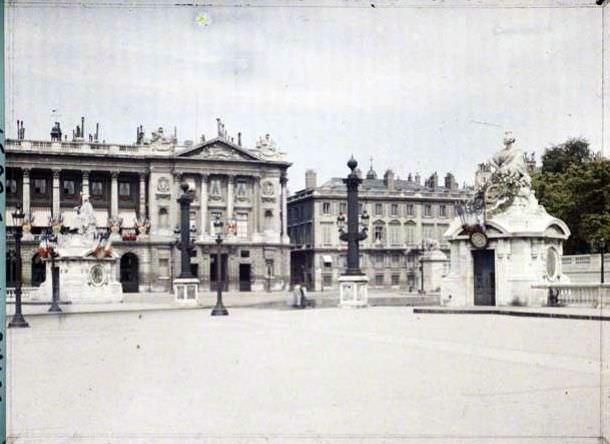
Across the broad openness of Place de la Concorde, the paired statues of Lille and Strasbourg stand like sentinels at the edge of Parisian grandeur, their pale stone catching the softened tones of a careful colorization. Ornate lampposts punctuate the expanse, while the monumental facades behind them—long rows of windows, classical pediments, and sculpted details—create a formal stage set that feels both ceremonial and lived-in.
Look closely and the square’s scale becomes the real subject: a wide sweep of roadway and paving that dwarfs the few passing figures and vehicles, suggesting a city built for processions as much as for everyday movement. The composition draws the eye from the allegorical sculptures toward the symmetry of the surrounding architecture, a visual reminder that Place de la Concorde has long been designed to impress, to order space, and to frame Paris as a capital of art and power.
Colorization adds a quiet immediacy, turning what might feel distant into something nearer—stone warmed slightly, greenery hinted at on the far right, and the atmosphere of a bright day lingering over the scene. For readers interested in Paris history, French public monuments, or the evolving identity of Place de la Concorde, this view offers more than a postcard moment: it’s a glimpse of how allegory, urban planning, and everyday life meet at one of the city’s most storied crossroads.