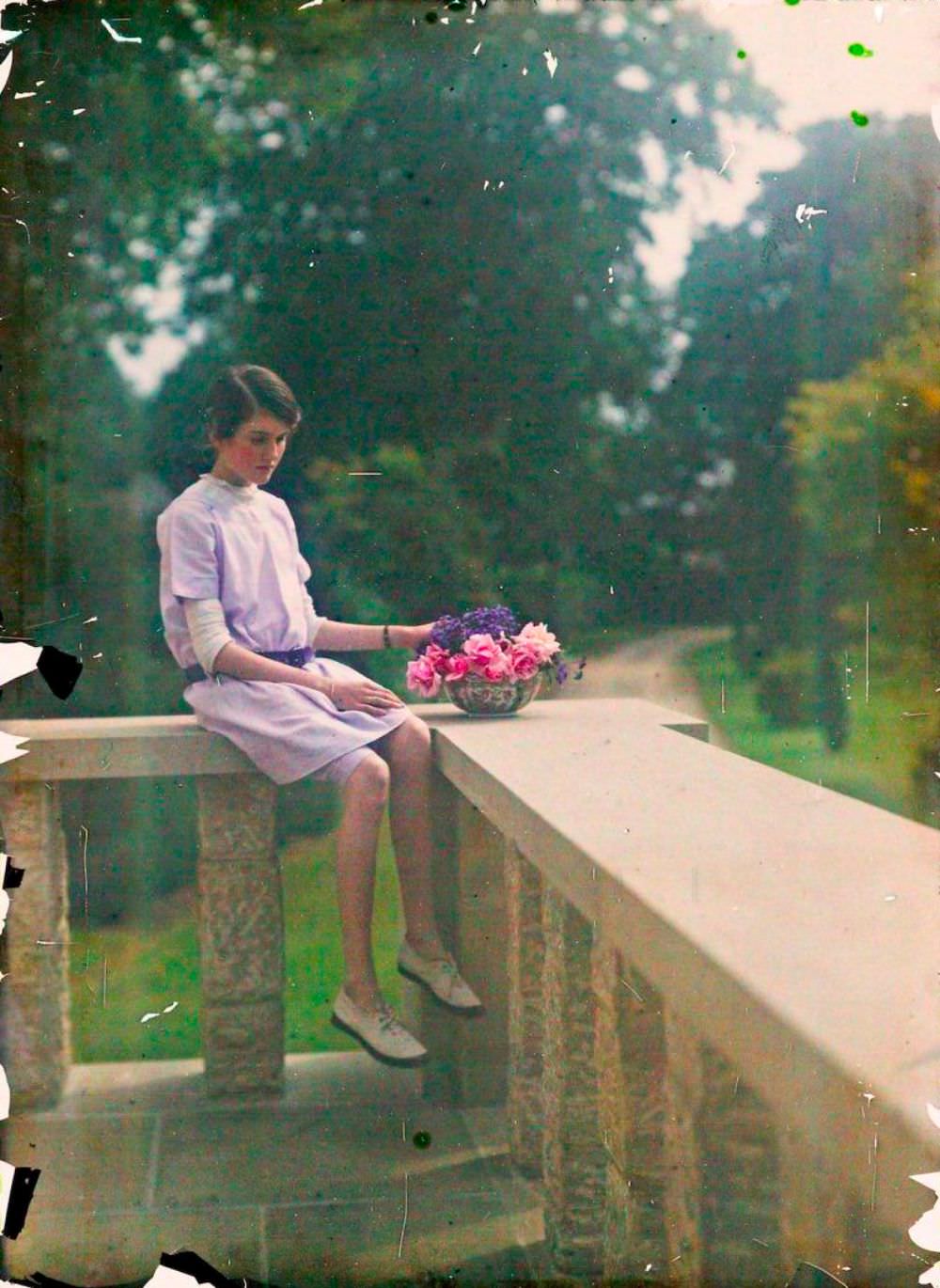
Soft daylight and a wash of early color surround a young girl seated on a stone balustrade, her posture quiet and reflective as she looks down toward a bowl of vivid blossoms. The autochrome palette lends the scene its unmistakable charm: greens melt into a painterly background while pinks and purples in the flowers pop against her pale dress. Scratches and specks across the frame remind us that this is a surviving physical plate, carried through more than a century of handling and time.
Autochrome photography, introduced in the first years of the 20th century, offered one of the earliest practical ways to capture the world in natural color rather than later “colorization.” That technical miracle came with its own look—soft focus, gentle contrasts, and a shimmering texture that feels closer to memory than to modern clarity. Here, the effect turns an ordinary moment outdoors into something almost dreamlike, emphasizing mood over sharp detail.
For readers searching for an authentic 1910 color photograph, this portrait is a striking example of how quickly photography began to move beyond monochrome documentation. The simple elements—garden-like greenery, a carefully chosen floral arrangement, and the girl’s understated clothing—hint at everyday life and aesthetics in the early 1900s without needing a caption full of specifics. As a historical image, it invites slow looking: not only at the subject, but at the fragile, luminous process that preserved her in color.