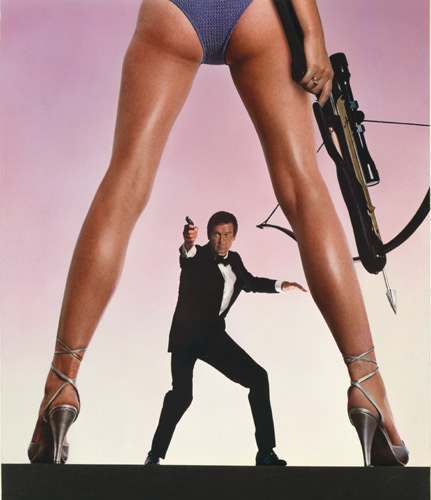
Few visual tricks in poster history feel as instantly legible as the “A-frame” stance: a confident figure planted wide, forming a human arch that frames the action. In this cover-style image, the viewer’s eye is guided through a pair of long, high-heeled legs toward a tuxedoed man in mid-motion, arm extended with a pistol, while a sleek crossbow-like weapon is held at the right edge. The clean gradient background and bold scale contrast turn a simple pose into a graphic device, equal parts glamour and threat.
That framing isn’t just cheeky—it’s engineered for impact, combining fashion photography’s emphasis on silhouette with cinema’s need for a clear focal point. The towering foreground body becomes both setting and symbol, compressing a story into a single, readable icon: danger, desire, and power arranged in one triangular composition. With its strong diagonals, sharp heels, and high-contrast styling, the image demonstrates how an “iconic pose” can become shorthand for an entire genre mood.
Modern fashion editorials, gallery art, and movie posters still borrow this same geometry because it sells attitude at a glance, especially in a scrolling, thumbnail-driven world. Designers and art directors return to the A-frame when they want instant hierarchy—foreground dominance, background hero, and a narrative corridor in between. As a piece of cover art, this example makes a persuasive case for why the pose persists: it’s not merely provocative, it’s an enduring compositional blueprint for pop culture storytelling.