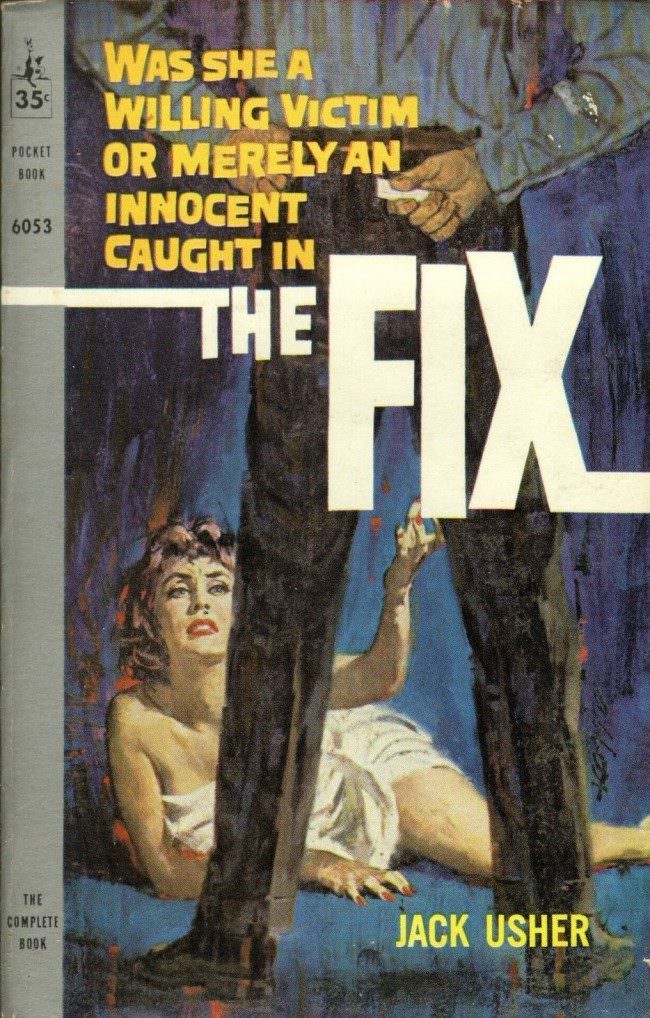
Bold pulp typography and a tightly staged silhouette do most of the storytelling here: a towering figure in dark trousers stands like an A-frame over a woman on the ground, while the massive title “THE FIX” slices across the center. The composition forces your eye to read power and peril through geometry—legs planted wide, the body forming a human frame—then drops you to the vulnerable gaze below, where a single outstretched hand turns the pose into a charged narrative hook. Even without a visible setting, the stark color blocks and high-contrast lighting cues evoke classic crime cover art and the era’s appetite for suspense.
What makes the A-frame so enduring is its instant, readable drama: it creates a stage, a boundary, and a point of view all at once. In fashion photography, the stance becomes a runway-ready power pose; in art and illustration, it’s a compositional tool that funnels attention; and in movie posters, it signals dominance, danger, or intrigue in a split second. This cover demonstrates how the human body can function as design—two angled lines anchoring the frame while the smaller figure and bold text deliver emotional impact and narrative ambiguity.
Look closely at the marketing language—“Was she a willing victim or merely an innocent caught in…”—and you can see how the pose works in tandem with sensational copy to sell tension and mystery. As a piece of vintage paperback cover art, it’s also a lesson in visual hierarchy: oversized lettering, saturated blues, and a dramatic foreground figure competing for attention while still guiding the viewer’s eye. For anyone tracing the A-frame’s influence on modern fashion, art, and poster design, this image offers a crisp example of why the pose remains iconic: it’s graphic, cinematic, and impossible to ignore.