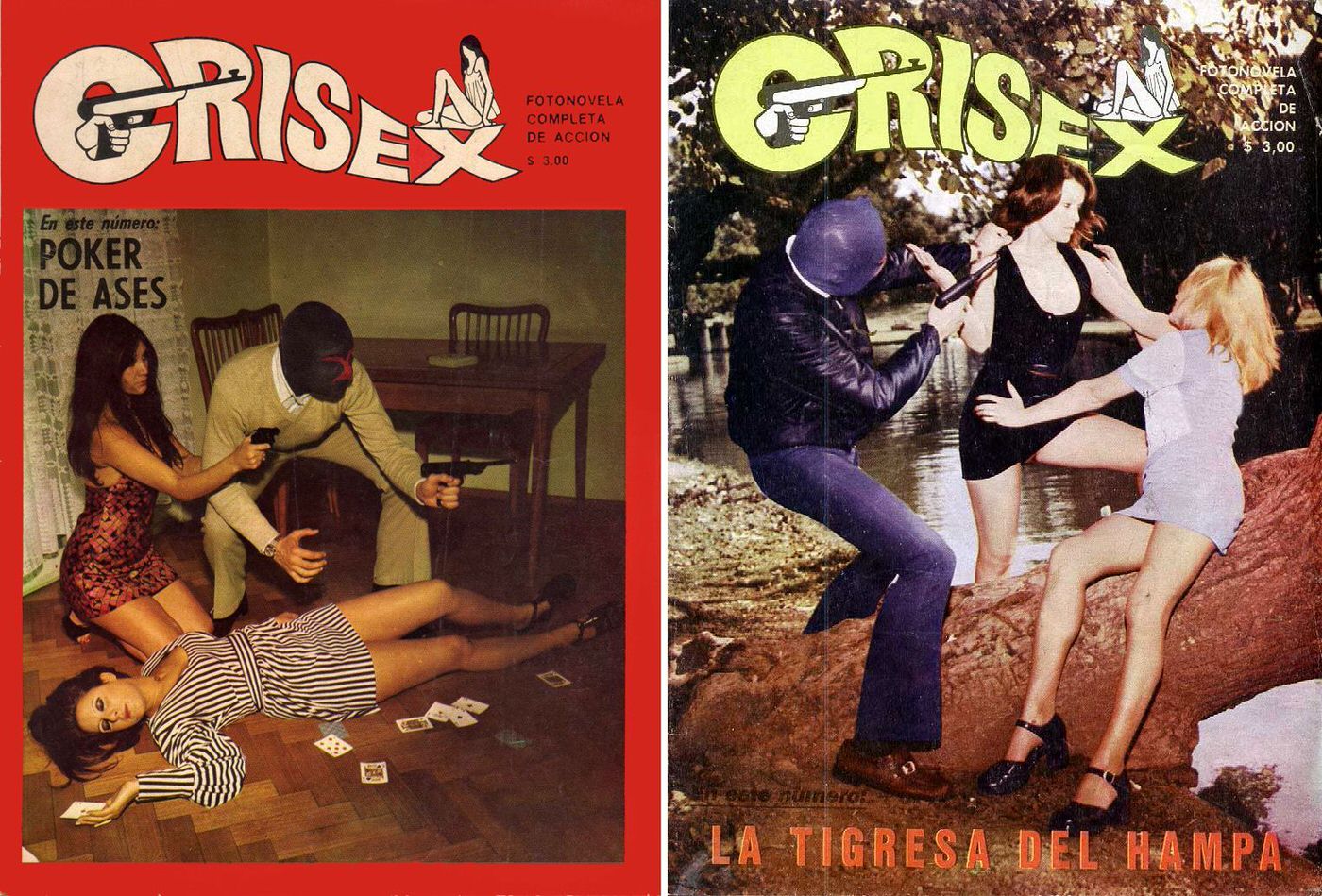
Lurid typography, pistol silhouettes, and staged peril leap off these “CRISEX” covers, a perfect entry point into the Spanish and Italian crime fotonovela boom of the 1960s–70s. Marketed as “fotonovela completa de acción,” the format sold suspense in a tabloid register—bold mastheads, bright blocks of color, and sensational taglines designed to grab a kiosk browser in seconds. Even the prices and issue blurbs printed on the covers become part of the period texture, anchoring the material in everyday popular culture rather than elite art circles.
On the left, the story hook is laid out like a pulp crime scene: a masked figure, a handgun, scattered playing cards, and a body posed on a parquet floor under the teasing title “Poker de Ases.” The domestic setting—plain table and chairs, curtained window, and tight interior framing—adds to the claustrophobia, as if danger has invaded an ordinary room. That mix of melodrama and prop-driven storytelling is quintessential fotonovela, where photographic realism is harnessed to deliver cliffhanger immediacy.
Across to the right, a riverbank confrontation escalates the spectacle, with a hooded attacker and two women caught mid-struggle beneath the headline “La Tigresa del Hampa.” The outdoor setting, the motion of arms and legs, and the high-contrast wardrobe signal action cinema translated into stills, borrowing the visual language of thriller posters while promising serialized narrative. For collectors and historians of European comics and popular print, these covers spotlight how crime comics, photo-stories, and exploitation aesthetics converged into a distinct mass-market genre that remains instantly searchable today under “fotonovelas,” “crime comics,” and “Spanish/Italian pulp cover art.”