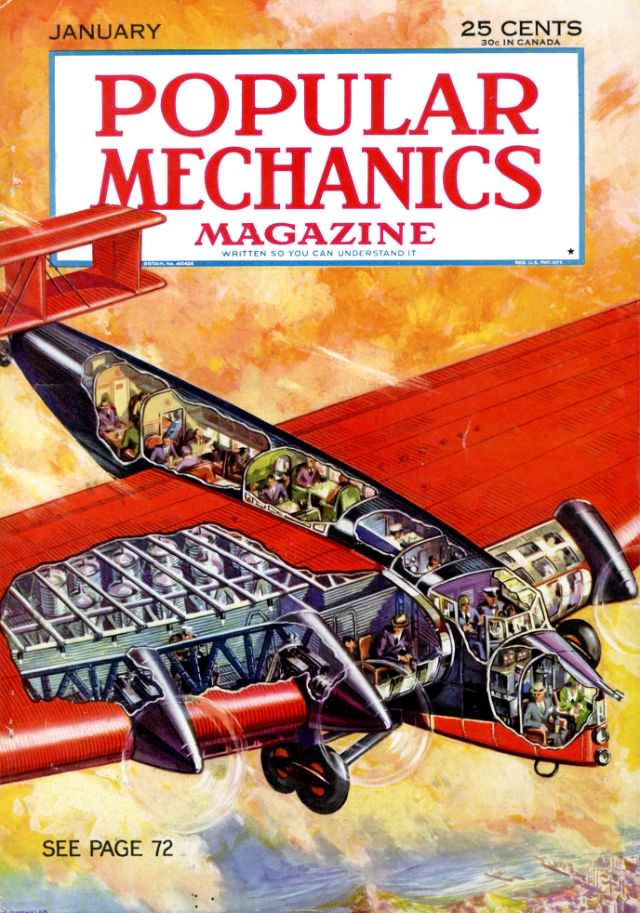
January 1933 arrives in bold red type across the familiar Popular Mechanics masthead, priced at 25 cents, with the magazine’s promise—“Written so you can understand it”—tucked beneath. The cover art leans into drama and clarity at once, using warm oranges and reds to push the reader’s eye straight into the machinery-and-motion world the publication celebrated. Even before a single article is opened, the layout sells confidence: modern engineering is exciting, understandable, and within reach.
Dominating the scene is a large aircraft rendered in a cutaway style, as if the fuselage has been peeled open for inspection. Cabins and compartments are exposed like a diagram, revealing seated passengers and crew at work while structural ribs, fuel or cargo spaces, and mechanical sections line up in neat perspective. The bright red wings and engines contrast with the intricate interior, turning technical curiosity into visual storytelling—part advertisement for progress, part lesson in how things are built.
Collectors and aviation history enthusiasts often gravitate to Popular Mechanics covers like this because they capture the era’s faith in technology as vividly as any article could. The illustration doubles as a snapshot of early-1930s popular science culture, when magazines translated complex transportation and industrial advances into approachable images for a mass audience. Whether you’re researching vintage magazine cover art, the history of flight, or the graphic language of American modernity, this January 1933 issue makes a striking centerpiece.