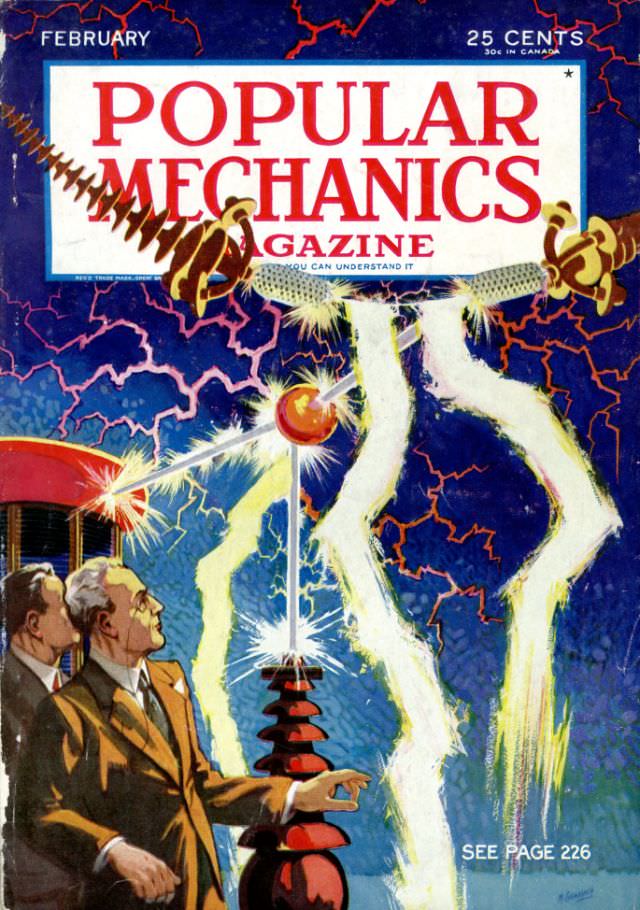
Bold red lettering announces **Popular Mechanics Magazine** across the top of this February 1933 cover, priced at 25 cents (30 cents in Canada), setting an energetic tone before the eye drops into a stormy field of electric blue. Jagged, lightning-like lines spread across the background while brilliant white arcs leap between metal components, turning the page into a dramatic stage for modern power. The composition feels like a promise that technology can be understood—and mastered—by anyone willing to look closely.
At the lower left, two suited observers watch the spectacle with the mix of caution and curiosity that high voltage inspires, their gaze following a glowing sphere and the crackling discharge around it. A stack of insulators anchors the scene, while the illustrated current branches upward in thick, luminous ribbons toward toothed and cylindrical hardware near the top edge. Even without technical captions on the artwork itself, the cover art communicates the era’s fascination with electricity, radio, and the expanding world of industrial engineering.
February 1933 sits in a moment when science and practical invention were marketed as both entertainment and empowerment, and this cover reflects that confident, instructional spirit. For collectors and researchers, it’s a vivid example of early 1930s magazine design—part advertising, part illustration, part public science lesson—made to stand out on a newsstand. Ideal for a WordPress post about vintage Popular Mechanics covers, Great Depression–era technology culture, or the history of electrical engineering in popular media, the piece also teases the reader with “SEE PAGE 226,” inviting a deeper dive inside.