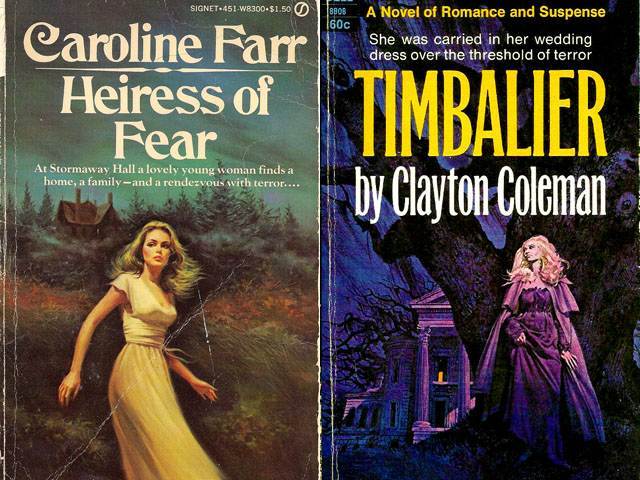
Two battered paperback covers sit side by side like artifacts from the heyday of gothic romance, their painted heroines caught mid-flight as if the paper itself can’t hold them. On the left, “Caroline Farr” and the title “Heiress of Fear” loom over a windswept landscape where a pale-dressed woman runs with her hair streaming, the distant house reduced to a brooding silhouette. On the right, “Timbalier” by Clayton Coleman leans into deep blues and purples, framing a mansion behind stark trees while a woman in a dramatic gown stands poised in uneasy light beneath the promise of “Romance and Suspense.”
That recurring figure—woman fleeing a house—works as a visual shorthand for peril, desire, and the thin boundary between sanctuary and trap that gothic romance loves to explore. The compositions pull your eye from the heroine’s exposed vulnerability to the architecture that dominates the horizon, suggesting secrets inside and consequences outside. Even the typography amplifies the psychological push-pull: oversized titles, urgent taglines, and high-contrast palettes all press the reader toward the same question—what happened in that house, and why must she run?
For anyone searching for gothic romance cover art, vintage paperback illustration, or the iconography of romantic suspense, these covers provide a compact lesson in how publishing sold emotion at a glance. The cracked spines and worn edges hint at hands turning pages late at night, when dread feels intimate and a getaway feels just possible. Seen together, they make a strong case that the appeal isn’t only the haunted mansion—it’s the charged moment of escape, where fear, agency, and longing collide on the cover.