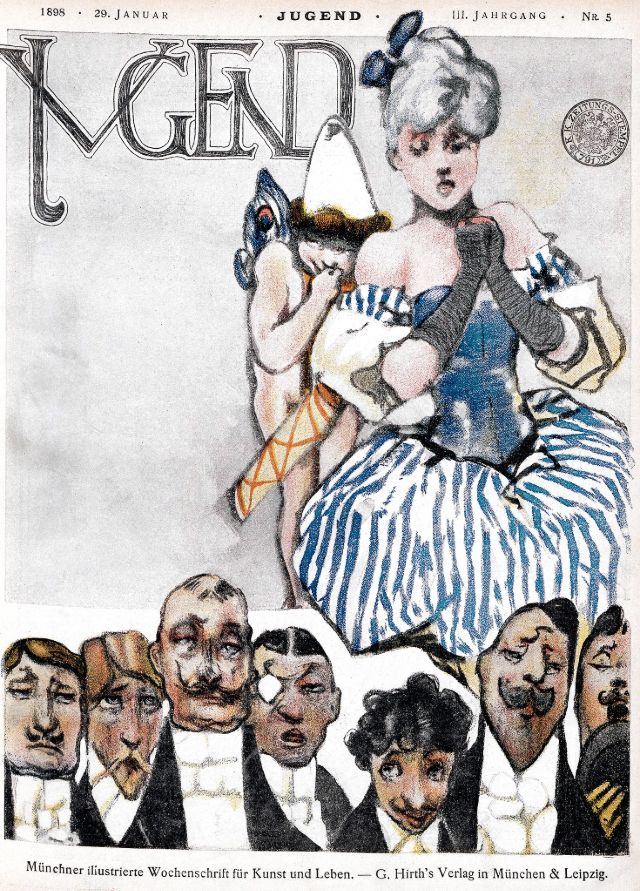
Across the top, the bold masthead “JUGEND” anchors a lively cover dated “29. Januar 1898,” immediately placing this artwork within the illustrated magazine culture of fin-de-siècle Germany. A fashionable young woman dominates the composition, her pale hair swept up with a dark bow and her dress rendered in crisp blues and whites that feel unmistakably poster-like. The delicate color accents and confident linework signal the era’s love of modern design and graphic elegance.
Behind her, a smaller, mischievous figure peeks out, adding a theatrical note—part backstage prank, part carnival wink—while the woman’s poised expression holds the viewer at a distance. Along the bottom edge, a row of male faces forms a compressed audience, each caricatured with distinct features and expressions that range from bored to amused. The contrast between the airy upper space and the crowded lower band creates a visual rhythm: glamour above, gawking commentary below.
For collectors and readers interested in Jugendstil aesthetics, satirical illustration, and German magazine cover art, this “Jugend, January 1898” issue offers a vivid snapshot of turn-of-the-century visual culture. Even without relying on specific identities, the scene reads as a commentary on performance, fashion, and spectatorship—themes that ran through popular print in the late 1890s. The publisher line at the bottom (“Münchner illustrierte Wochenschrift für Kunst und Leben”) further underlines the magazine’s ambition to blend art and everyday life on a single, memorable page.