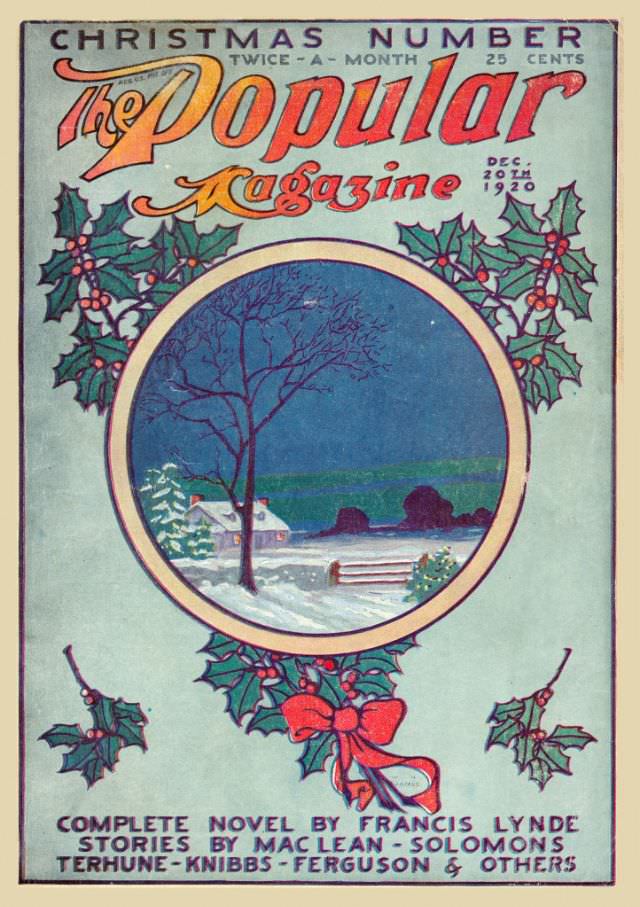
Holiday marketing in the early 1920s leaned heavily on bold lettering and instantly readable seasonal cues, and the December 20, 1920 cover of The Popular Magazine is a vivid example. Branded as a “Christmas Number,” it pairs an eye-catching masthead with festive holly sprigs, berries, and a ribbon that frame the page like a storefront decoration. Even the small details—such as the “twice-a-month” rhythm and the 25-cent price—hint at a lively, competitive magazine culture built on frequent releases and impulse buys.
At the center, a circular winter vignette invites the viewer into a quiet countryside night: snow laid thick, a bare tree silhouetted against a deep blue sky, and a small house glowing warmly in the distance. The contrast between the icy landscape and the suggestion of lighted windows creates a sense of comfort and anticipation, the kind of atmosphere that sells a seasonal issue as much through mood as through content. A fence line and softly rolling forms in the background keep the scene simple and story-ready, like an opening paragraph waiting to be read.
Printed cover art like this served as both advertisement and promise, signaling that a reader would find wintertime entertainment inside—novels and short stories for long evenings by the lamp. For collectors, designers, and historians of periodicals, this Popular Magazine cover offers a snapshot of early twentieth-century American visual taste: decorative borders, romantic landscape imagery, and confident typography competing for attention on the newsstand. It’s a compact piece of Christmas ephemera that still reads clearly today, bridging nostalgia, graphic design history, and the popular fiction marketplace of its era.