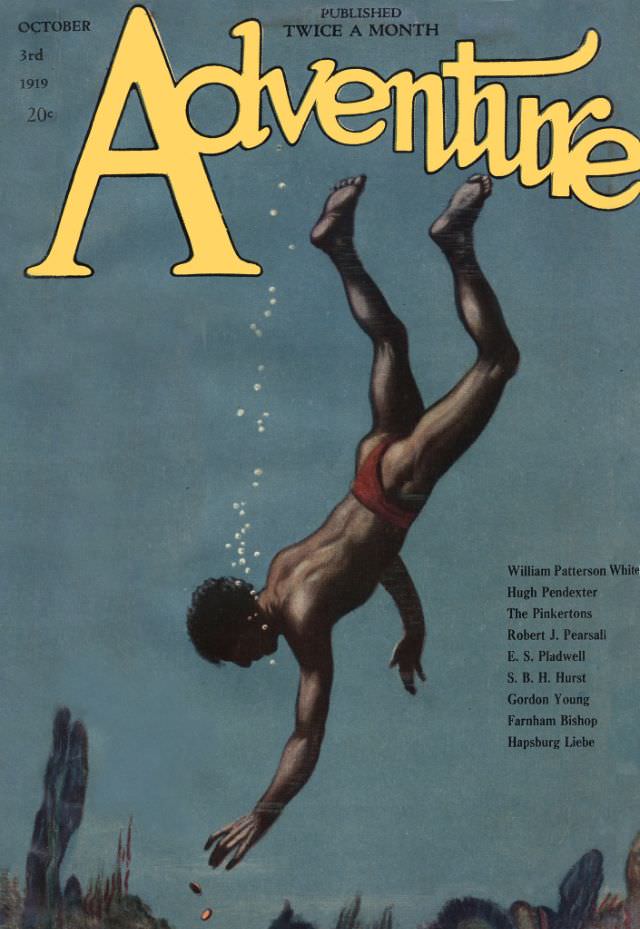
Bold yellow lettering spelling “Adventure” stretches across the top of the October 3, 1919 cover, immediately setting a pulp-era tone with its confident, hand-drawn flair. Small masthead details—“Published twice a month,” the date, and a 20-cent price—frame the magazine as a lively periodical meant to be bought often and read fast. Along the right side, a vertical list of contributors anchors the artwork in the world of popular fiction, where names mattered and covers worked as instant promises of thrills.
Under the title, a dramatic underwater scene takes over: a lone diver, rendered in rich color, drifts downward with limbs extended and bubbles rising toward the surface. The figure’s posture suggests sudden peril or a breath held too long, while the sea floor below hints at reefs, rocks, and the suggestion of hidden hazards. The composition uses open water as suspenseful negative space, letting the viewer feel the weight of depth and the uncertainty of what might be just out of sight.
As cover art, it’s a time capsule of early 20th-century adventure illustration, when magazines competed on newsstands with spectacle, movement, and a touch of danger. The clean typography against the watery background, the carefully modeled anatomy, and the cinematic angle all point to a visual language designed to hook readers in a single glance. For collectors and researchers searching for “Adventure magazine cover October 3 1919,” this image offers a vivid example of how pulp publishing sold excitement—one breath, one plunge, and one cliffhanger at a time.