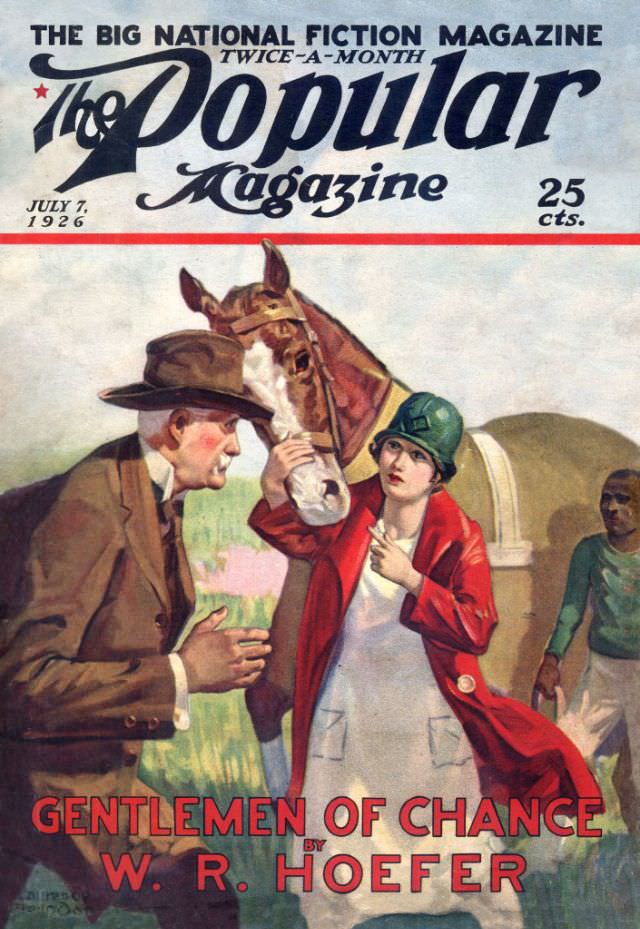
Bold lettering across the top announces “The Popular Magazine,” billed as “The Big National Fiction Magazine” and issued “Twice-a-Month,” with the July 7, 1926 date and a 25-cent price printed like a promise of affordable escape. The cover’s design leans into the era’s love of dramatic, readable typography, where masthead and taglines compete for attention before the story art even begins. For collectors of 1920s magazine covers and pulp-era publishing, these details are part of the artifact’s charm, anchoring the illustration in a world of newsstands, commuters, and serialized thrills.
At center stage, a tense trackside moment unfolds: a brown horse in bridle stands between an older man in a brimmed hat and a stylish young woman in a green cloche. Her bright red coat and pale dress pop against a soft outdoor backdrop, while her raised hand near the horse’s face suggests reassurance—or warning—at precisely the wrong moment. The man’s forward-leaning posture and animated hands add urgency, as if an argument, a wager, or a sudden revelation has broken through the ordinary rhythm of the grounds.
Down below, the story title “GENTLEMEN OF CHANCE” and the author credit “W. R. HOEFER” frame the illustration as pure narrative bait, the kind that made popular fiction magazines a cultural engine of their time. Even the partially seen figure at the right edge hints at a wider scene beyond the frame, inviting readers to imagine the crowd, the stakes, and the consequences. As cover art, it’s a compact lesson in how 1920s periodicals sold atmosphere—romance, risk, and motion—before a single page was turned.