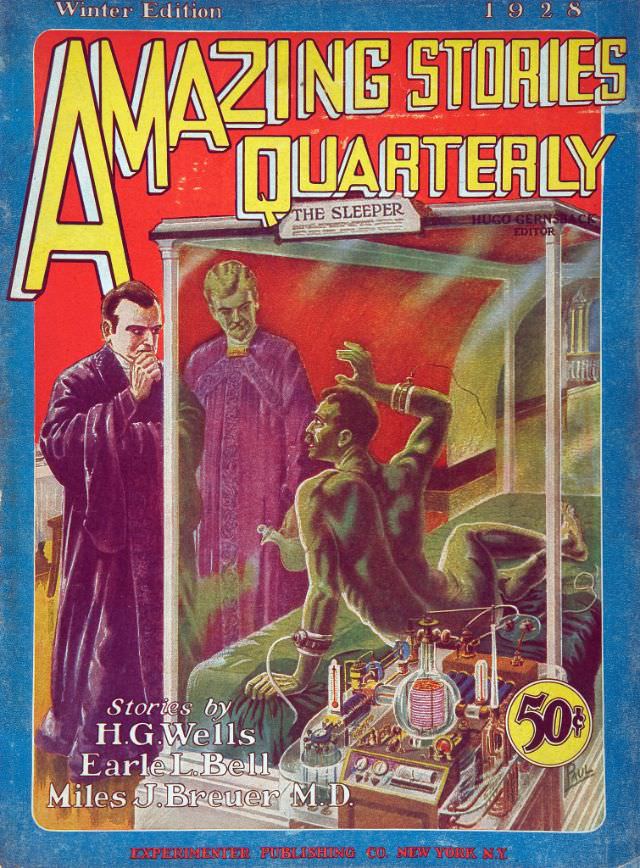
Bold lettering shouts “Amazing Stories Quarterly” across a Winter Edition cover marked 1928, immediately setting the tone for early science fiction’s pulp-era spectacle. The palette is loud and theatrical—deep reds and electric blues framing a dramatic scene—while the cover’s design balances typography, illustration, and the irresistible newsstand lure of a prominent 50¢ price.
At the center, a laboratory-like chamber becomes a stage for unease: a muscular figure recoils with raised arms, metal bands clamped at wrists and ankles, as if restrained by an unseen force or experimental apparatus. Two robed observers stand nearby—one in the foreground with a tense, contemplative pose, another behind a glassy partition—suggesting a tale of science, control, and moral consequence that fits the magazine’s promise of strange inventions and boundary-pushing ideas.
Details along the bottom edge reinforce the issue’s identity as collectible cover art: the authors’ names are printed in large type, with H. G. Wells among them, anchoring the fantasy in a recognizable literary pedigree. For readers and collectors searching “Amazing Stories cover Winter 1928,” this illustration offers a vivid snapshot of how popular magazines sold wonder and dread in a single frame, marrying futuristic machinery, human drama, and the era’s unmistakable visual flair.