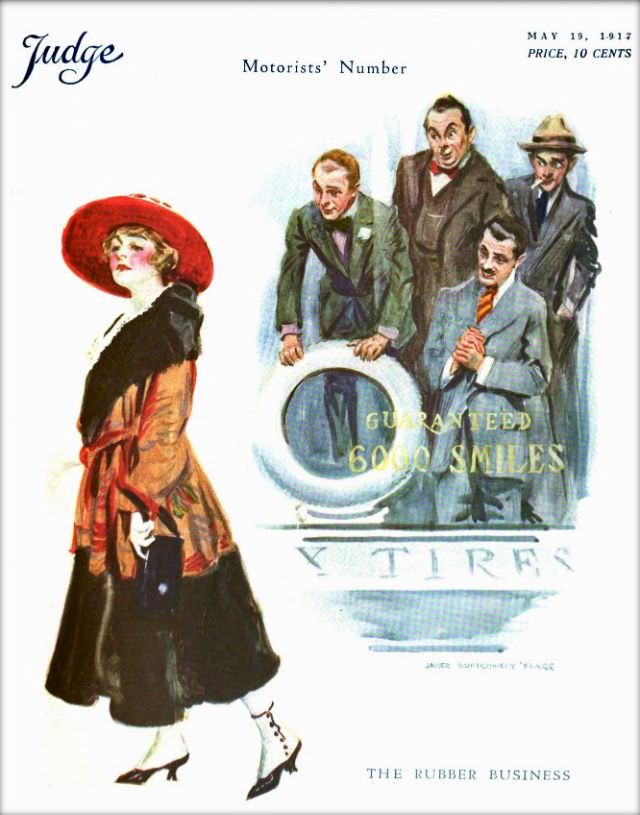
Judge’s May 19, 1917 cover leans into the “Motorists’ Number” theme with a witty, advertisement-like tableau that feels instantly modern. A fashionable woman in a wide red hat strides past, her confident silhouette set against the pale background, while a cluster of suited men hovers near an oversized tire. The composition balances elegance and commerce, using bold color accents and theatrical spacing to pull the eye from figure to product.
At the center, the tire itself is treated like a prized object, stamped with the promise “Guaranteed 6000 miles,” and labeled for “V Tires,” echoing the persuasive language motorists would have seen in early automotive marketing. The men’s expressions—curious, approving, and slightly conspiratorial—suggest a sales pitch as much as a joke, underscoring Judge magazine’s knack for satirizing everyday consumer culture. Even without a detailed street scene, the image evokes an era when cars, accessories, and reliability claims were reshaping habits and expectations.
Small printed details anchor the piece in its original moment: the Judge masthead, the issue date, and the price of 10 cents, along with the caption “The Rubber Business.” For collectors of antique magazine covers, early 20th-century illustration, or automotive history ephemera, this scan offers a crisp example of how humor publications borrowed the visual language of advertising. It’s a lively artifact of 1917 print culture—part fashion plate, part consumer commentary, and entirely designed to catch a passerby’s glance on a newsstand.